


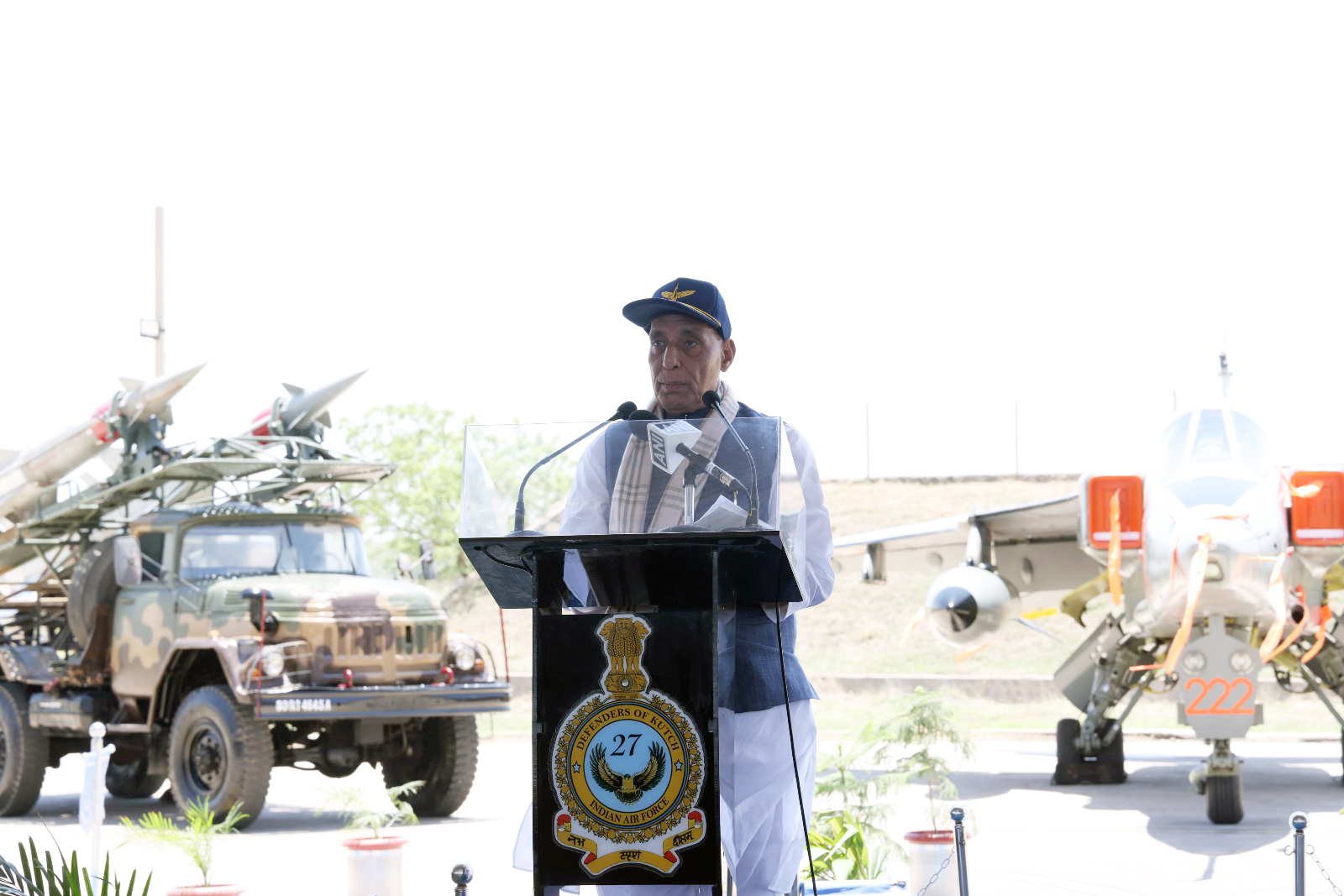
Kolkata: Defence Minister Rajnath Singh has called on India’s Armed Forces to transcend traditional concepts of war and remain prepared for unconventional challenges, including information, ideological, ecological and biological warfare. Speaking at the Combined Commanders’ Conference 2025 in Kolkata, he urged commanders to maintain constant vigilance amid a volatile global order, regional instability and an evolving security landscape.
Singh underlined the shifting character of warfare, noting that modern conflicts are “sudden and unpredictable”. He warned that the duration of wars today could range from months to years, making it essential for India to retain sufficient surge capacity.
Positioning India’s defence establishment as a fusion of offensive and defensive capabilities, the Defence Minister pressed the leadership to adopt a proactive stance and accelerate the building of the “Sudarshan Chakra” defence system, as envisioned by Prime Minister Narendra Modi. A dedicated committee has been tasked with developing a realistic action plan, with both medium-term (five years) and long-term (ten years) strategies.
He highlighted that the nation’s defence strategy is firmly anchored in modernisation, operational readiness, technological superiority and credible deterrence. Referring to the Prime Minister’s guiding mantra of “JAI – Jointness, Aatmanirbharta (self-reliance) and Innovation”, Mr Singh stressed closer collaboration with industry and academia to cultivate future-ready technologies. He also reiterated the government’s intent to strengthen private sector participation in defence manufacturing, positioning India as a global hub of defence innovation.
On jointness, the Defence Minister emphasised that seamless coordination between the three services and other national agencies was “essential” to address emerging challenges. He cited the creation of Tri-Service Logistics Nodes and a Tri-Service Logistics Management Application as examples of efforts towards integration, alongside growing civil-military cooperation.
Commending the Armed Forces for their professionalism during Operation Sindoor, Mr Singh said the mission demonstrated that “Strength, Strategy and Self-reliance are the three pillars that will give India the power it needs in the 21st century”. He underscored that India today possesses the indigenous capability to respond to any crisis, bolstered by the courage of its personnel.
Reinforcing the government’s commitment to Aatmanirbhar Bharat, he asserted that self-reliance is not a slogan but a necessity, forming the foundation of strategic autonomy. Defence indigenisation, he said, is simultaneously spurring economic growth, creating jobs, and enhancing the capacities of shipyards, aerospace clusters and defence corridors—delivering a significant multiplier effect across the economy.
Singh also announced his approval of the Defence Procurement Manual 2025, designed to streamline acquisition processes. Additionally, the Defence Acquisition Procedure 2020 is being revised with the aim of simplifying procedures, reducing delays, and ensuring timely operational strength for the Armed Forces.
The conference was attended by Chief of Defence Staff General Anil Chauhan; Chief of the Naval Staff Admiral Dinesh K Tripathi; Chief of the Army Staff General Upendra Dwivedi; Chief of the Air Staff Air Chief Marshal AP Singh; Defence Secretary Rajesh Kumar Singh; Defence Production Secretary Sanjeev Kumar; Ex-Servicemen Welfare Secretary Dr Niten Chandra; Defence R&D Secretary and DRDO Chairman Dr Samir V Kamat; Financial Advisor (Defence Services) Dr Mayank Sharma; along with other senior officials.