

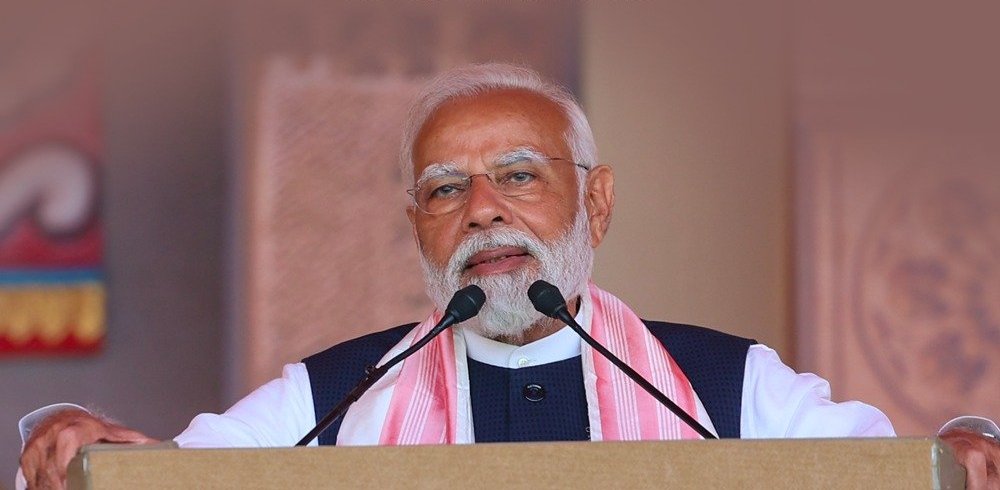
Mumbai: Prime Minister Narendra Modi inaugurated the much-awaited Navi Mumbai International Airport and Mumbai’s first fully underground metro line, marking a historic leap in Maharashtra’s infrastructure growth. Addressing a massive gathering in Mumbai, the Prime Minister described these developments as a reflection of India’s journey towards becoming a Viksit Bharat — a developed nation that balances speed, progress, and people’s welfare.
The event was attended by Maharashtra Governor Acharya Devvrat, Chief Minister Devendra Fadnavis, Deputy Chief Ministers Eknath Shinde and Ajit Pawar, and Japan’s Ambassador to India, Keiichi Ono, among others.
Mumbai Gets Its Second International Airport
“This is a historic day for Mumbai,” said PM Modi, announcing the formal launch of the city’s second international airport. “This airport will help make this region one of Asia’s largest connectivity hubs.”
Built in the land of Chhatrapati Shivaji Maharaj, the Navi Mumbai International Airport is designed in the shape of a lotus — symbolising Indian culture (Sanskriti) and prosperity (Samriddhi). The Prime Minister said the airport would directly connect farmers to international markets in Europe and the Middle East, reducing export costs for small and medium industries and creating a wave of investment and new enterprises.
He also paid tribute to Maharashtra’s late leader D. B. Patil, whose dedication to farmers, he said, “will continue to inspire generations.”
Mumbai’s First Underground Metro – A Symbol of New India
PM Modi also launched Mumbai’s first fully underground metro line, built with cutting-edge engineering techniques to protect the city’s historic structures. “This metro will make daily commuting easier and save valuable time,” he said. What once took two hours will now take only 30–40 minutes, he noted.
However, the Prime Minister criticised the previous government for stalling metro construction midway, calling it “a great injustice” to the people of Mumbai. “They gained power, but the country suffered losses worth thousands of crores,” he said.
Expanding Air Connectivity: From 74 to Over 160 Airports
Recalling his vision from 2014 — that even a person wearing slippers should be able to afford an air ticket — PM Modi said his government’s airport expansion policy had turned that dream into reality. “When I took office, India had only 74 airports. Today, we have crossed 160,” he stated proudly.
He credited the UDAN (Ude Desh ka Aam Naagrik) scheme for democratising air travel, allowing millions of first-time flyers to take to the skies. “Today, India is the third-largest domestic aviation market in the world,” he added.
The Prime Minister also highlighted that Indian airlines have placed orders for nearly 1,000 new aircraft, which will generate a surge in jobs for pilots, engineers, cabin crew, and ground staff. To support this, the government is building new Maintenance, Repair and Overhaul (MRO) facilities across the country, aiming to make India a global MRO hub by the end of the decade.
Youth and Employment: The Driving Force
PM Modi underlined that India’s greatest strength lies in its youth. He spoke of the newly launched PM Setu Scheme worth ₹60,000 crore to connect ITIs with industry, along with Maharashtra’s new technical training programmes focused on drones, robotics, EVs, solar energy, and green hydrogen. “Every government policy is aimed at creating jobs for our youth,” he said.
He also mentioned upcoming projects like the ₹76,000 crore Vadhavan Port, which he said will generate large-scale employment while boosting trade and logistics.
‘One Nation, One Mobility’ Vision
Reaffirming his government’s commitment to ease of living, the Prime Minister spoke of the country’s efforts to integrate all modes of transport under the One Nation, One Mobility vision. The newly launched Mumbai One App, he explained, would allow people to buy a single ticket for use across local trains, buses, metros, and taxis. “No more standing in long queues,” he said.
Projects like Atal Setu, the Coastal Road, and the underground metro, he said, were proof of the government’s resolve to make travel seamless, fast, and affordable.
Sharp Words for Congress on National Security
Taking a strong stance on national security, PM Modi recalled the 2008 Mumbai terror attacks, saying the Congress government of the time had shown “a message of weakness and surrender.” Referring to a recent revelation by a senior Congress leader, Modi said the nation deserved to know why the government back then stopped Indian forces from retaliating against Pakistan. “Who stopped India from striking back? The country has the right to know,” he said.
In contrast, he said, “Today’s Bharat gives a befitting reply. We strike the enemy on their soil. The world saw our strength during Operation Sindoor.”
Boost to the Middle Class and Swadeshi Appeal
PM Modi also noted that the purchasing power of the middle class has grown due to GST reforms and a fall in prices. “This Navratri, record sales were seen across markets — from scooters to refrigerators,” he said.
He urged citizens to embrace Swadeshi (local) products. “Say with pride — this is Swadeshi! If every family starts buying Indian-made goods, the nation’s money will stay within the nation and give work to our labourers and youth,” he said, calling it the new mantra for self-reliance.
The Road Ahead
Concluding his address, PM Modi said the double-engine government at the Centre and in Maharashtra would continue to work tirelessly to strengthen every city and village. “Every rupee spent on infrastructure is meant to enhance the convenience and capability of our citizens,” he said.
With chants of “Bharat Mata Ki Jai” echoing through the venue, the Prime Minister’s message was clear — development, progress, and self-reliance will continue to define India’s journey toward becoming a Viksit Bharat.