


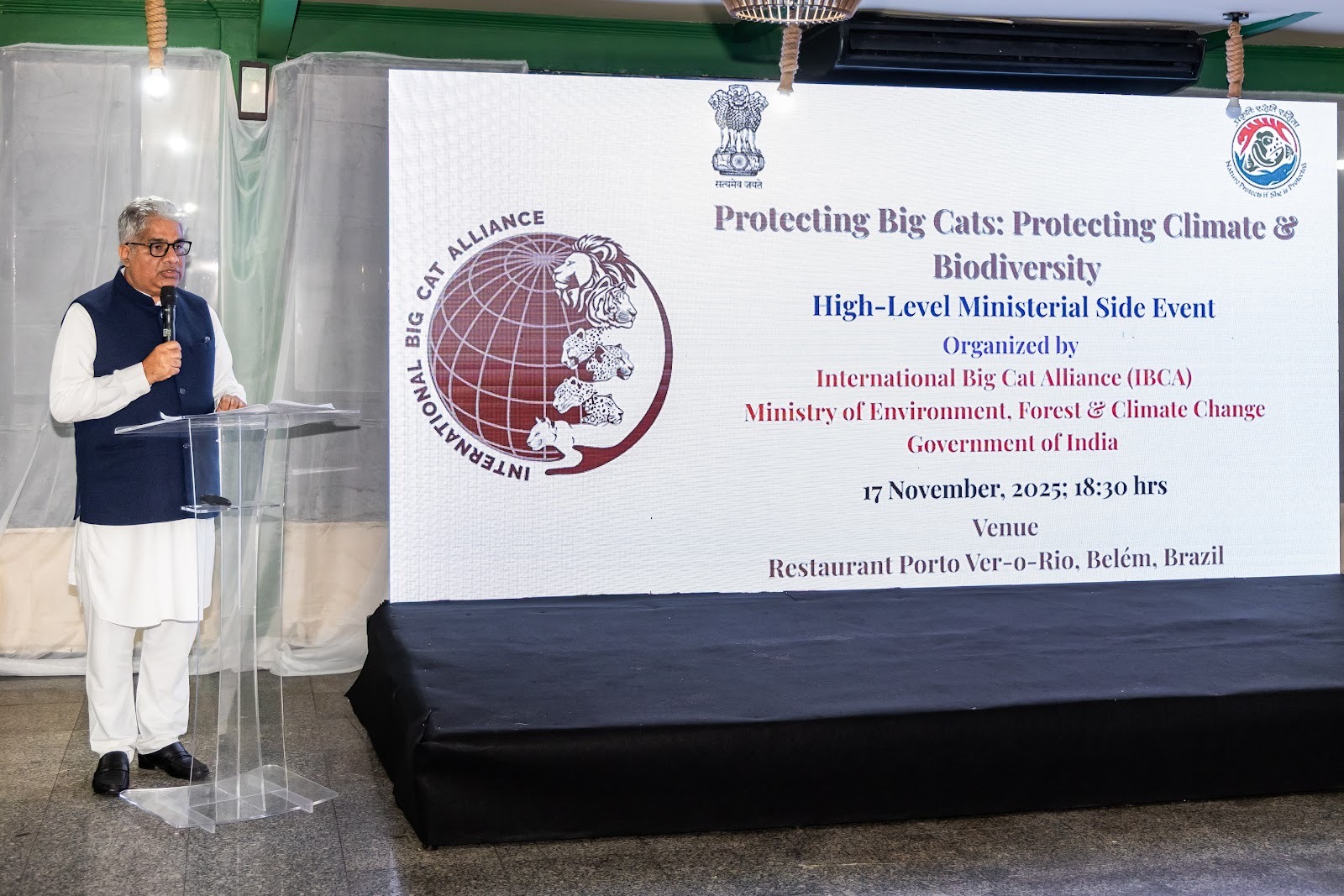
Belém, Brazil / New Delhi: India reaffirmed its global leadership in wildlife conservation on the world stage as Union Environment Minister Bhupender Yadav addressed the High-Level Ministerial Segment on the International Big Cat Alliance (IBCA) during the UN Climate Change Conference (CoP30) held in Belém, Brazil.
Delivering India’s intervention on Monday, Yadav called for stronger international cooperation to protect big cat species and their natural habitats, linking their conservation directly with climate mitigation, adaptation, and ecosystem resilience. The event was attended by key leaders, including Nepal’s Minister of Agriculture and Livestock, Dr Madan Prasad Pariyar.
Yadav thanked the host country Brazil and highlighted the importance of the session’s theme — “Protecting Big Cats, Protecting Climate and Biodiversity.” He reminded the global audience that ecological challenges are interconnected, requiring comprehensive and collaborative solutions. “Big cats are apex predators, regulators of ecological balance, and sentinels of ecosystem health,” he stated. “Where big cats thrive, forests are healthier, grasslands regenerate, water systems function, and carbon is stored efficiently in living landscapes.”
The Minister warned that declining big cat populations could lead to ecosystem imbalances, reduced climate resilience, and the loss of natural carbon sinks. He urged countries to recognise “Big Cat Landscapes” as Nature-Based Climate Solutions, stressing that wildlife conservation itself is a powerful form of climate action.
“What we often call ‘wildlife conservation’ is, in fact, climate action in its most natural form,” Yadav said, explaining that conserving big cat habitats directly enhances carbon storage, watershed protection, disaster risk reduction, and sustainable livelihoods for local communities.
The Minister outlined the potential of the International Big Cat Alliance to help member countries through technical assistance, capacity building, shared resources, and innovative financing models such as biodiversity-carbon credits.
Emphasising India’s pivotal role, Yadav highlighted that the country is home to five of the world’s seven big cat species — the tiger, lion, leopard, snow leopard, and clouded leopard. He noted India’s success in doubling its tiger population ahead of the target year and its ongoing progress in protecting Asiatic lions. India, he said, has one of the world’s most advanced wildlife databases, tracking populations of key species while working closely with local communities to expand conservation areas and promote eco-friendly livelihoods.
Yadav also drew attention to the growing global participation in IBCA — a vision introduced by Prime Minister Narendra Modi, inspired by the principle “One Earth, One World, One Future.” Currently, 17 nations are formal members of the Alliance, while more than 30 others have expressed interest in joining.
In a major announcement, the Minister declared that India will host the Global Big Cats Summit in New Delhi in 2026, inviting all range countries to collaborate and share experiences in protecting big cats and their ecosystems.
Calling for unity in conservation, Yadav concluded with a powerful message: “We must collaborate, not compete. We must find strength not in isolation, but in solidarity. Protecting big cats is protecting our shared planet. Protecting big cats is protecting our future.”