

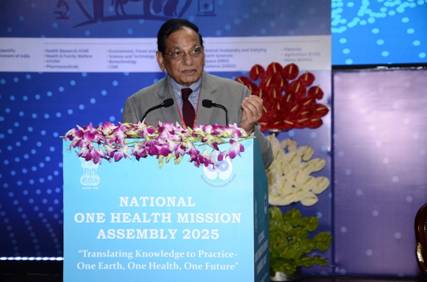
New Delhi: The National One Health Mission Assembly 2025 wrapped up on Friday at Bharat Mandapam after two days of intensive discussions, practical insights and cross-sectoral collaboration. What unfolded was more than a conference — it was a clear call to action for building a stronger, better-prepared One Health ecosystem that connects human health, animal health and environmental resilience.
Day 2 carried forward the momentum set on the opening day, bringing senior officials, scientific institutions, state representatives and global partners onto a single platform. Their message was unified: India’s approach to health security must be coordinated, science-driven and firmly rooted in community participation.
Dr V K Paul, Member (Health), NITI Aayog, set the tone with a candid but forward-looking message. He emphasised that India’s progress hinges on whole-of-government action and the ability to work seamlessly across ministries and systems. According to him, communities remain “the first and strongest line of defence”, whether in early disease detection or rapid emergency response. He reminded the gathering how community mobilisation played a pivotal role during the COVID-19 pandemic, and stressed that preparedness must reach all the way to the grassroots.
Alongside him, senior scientific leaders including Dr Rajiv Bahl of ICMR and Dr Rajesh S Gokhale from the Department of Biotechnology highlighted the urgency of scaling innovation and building faster, smarter medical countermeasures. They underlined the need for diagnostics, vaccines and therapeutics that can be deployed at speed during outbreaks. Their remarks pointed to a future where biological, artificial and natural intelligence converge, reshaping the country’s technological capabilities.
The Assembly also witnessed strong contributions from state governments, who shared operational experiences from the ground — including surveillance challenges, inter-departmental coordination and field-level response systems. Representatives from FAO, DRDO, ICAR, THSTI, AYUSH, CEPI, FIND and the International Vaccine Institute broadened the dialogue with global and multisectoral perspectives.
A major highlight of the day was an exhibition showcasing India’s growing strengths in surveillance technologies, biosafety systems, digital health platforms and laboratory networks. The National One Health Hackathon also drew attention, celebrating young innovators and student teams who developed practical prototypes aimed at solving real-world One Health challenges.
Sessions on capacity building and community engagement placed a spotlight on human resources — the need to expand training, integrate One Health into professional education, and empower local communities as active partners. Speakers stressed that preparedness is not just about high-end labs or advanced research, but also about the everyday readiness of frontline workers, local leaders and citizens.
As the Assembly concluded, the sentiment across the room was unmistakably aligned: achieving the vision of Viksit Bharat requires scientific excellence, strong partnerships, and a society that is prepared at every level. The National One Health Mission Assembly has clearly set the pace for a more coordinated, resilient and future-ready India.