


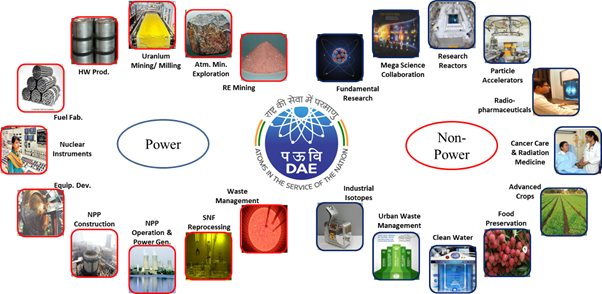
New Delhi: As 2025 draws to a close, the Department of Atomic Energy (DAE) stands tall on a year of historic growth, innovation, and service. From record nuclear power generation to advancements in healthcare, research, and national security, the DAE has lived up to its mandate — using atomic science to power and protect India.
It’s been a landmark year for the Department, both within India and on the global stage. The National Power Corporation of India Limited (NPCIL) registered its highest-ever annual generation of 56,681 million units (MUs) of electricity in FY 2024–25, marking an all-time peak in India’s nuclear energy story. The achievement also prevented an estimated 49 million tonnes of carbon dioxide emissions, underlining the government’s push for clean and sustainable energy.
Powering India with Atoms
The momentum continued when Prime Minister Narendra Modi laid the foundation stone for the four-unit Mahi Banswara Nuclear Power Project in Rajasthan on 25 September 2025. To be developed by the NPCIL-NTPC joint venture ASHVINI, the project will feature four 700 MW Pressurised Heavy Water Reactors (PHWRs) — a major stride toward India’s 2032 goal of achieving 22.5 GW nuclear power capacity.
Adding to this, Unit 7 of the Rajasthan Atomic Power Project (RAPP-7) became operational on 15 April 2025, becoming the third indigenous 700 MW PHWR to start commercial operations. Meanwhile, Kakrapar Nuclear Power Station units 3 and 4 received their regulatory nod for regular operations earlier in the year.
The Atomic Energy Commission also cleared the path for pre-project activities for ten additional 700 MWe PHWRs, a step that will further expand India’s nuclear fleet. Together, these achievements cement India’s position among the world’s fastest-growing nuclear energy producers — and demonstrate how indigenous technology is shaping a self-reliant energy future.
Expanding the Reach of Nuclear Medicine
If one pillar of DAE’s success in 2025 was energy, the other was definitely healthcare. The year witnessed the inauguration of a 150-bed Homi Bhabha Cancer Hospital and Research Centre in Muzaffarpur, Bihar, by the Prime Minister. Designed to bring advanced cancer care to regions that previously lacked such facilities, the hospital adds to the expanding national cancer network led by the Tata Memorial Centre (TMC).
TMC itself set new records, registering 1.3 lakh patients in FY 2024–25 and screening around 5 lakh women across its regional centres for oral, breast, and cervical cancers. New diagnostic and therapeutic tools — such as the 177Lu-DOTA-FAPI-2286 therapy and five innovative precision diagnostics — were introduced to improve treatment outcomes and accessibility.
Medical technology also saw historic use this year. The 30 MeV Medical Cyclotron Facility in Kolkata delivered 371 curies of radiopharmaceuticals for cancer diagnostics, ensuring advanced imaging services across hospitals. Meanwhile, Indore’s electron beam sterilisation facility crossed 1.53 crore sterilised medical devices, exported to over 35 countries including the UK, France, and South Africa. In another world-first, ISOMED 2.0, a high-intensity stationary gamma irradiator developed in India, was completed to serve the global healthcare industry.
Research and Innovation: India Steps Forward
In science and technology, 2025 saw India’s research institutions pushing boundaries that once seemed out of reach. The Bhabha Atomic Research Centre (BARC) released India’s first-ever Certified Reference Material (CRM) for Rare Earth Elements (REEs) — named Ferrocarbonatite (FC)–BARC B1401. This material is vital for precise mineral exploration and extraction of REEs used in electronics, defence, and clean energy technologies. Impressively, India now joins just three other countries globally with such capability.
Further breakthroughs came from the Nuclear Fuel Complex (NFC), which successfully produced high-purity Niobium ingots and sheets — a material essential for cutting-edge accelerator and space programmes. In a similar vein, the Niobium Thermit Production Facility, set up in collaboration with Vikram Sarabhai Space Centre (VSSC), produced its first batch of Niobium oxide, strengthening the partnership between atomic and space research.
Meanwhile, the Heavy Water Board (HWB) achieved a milestone by enriching Boron-11 to 99.8% purity, a material vital for semiconductors — highlighting how atomic research is now fuelling India’s electronics aspirations too.
At a scientific front, the Institute of Mathematical Sciences (IMSc) developed a simple yet highly accurate model using the Gompertz formula to predict newborn weight based on ultrasound data. This innovation promises early detection of foetal growth issues, with far-reaching implications for maternal health care in India.
And in a move blending cosmic curiosity with Indian expertise, the Indian Dark Matter Search Experiment (InDEx) began its first run at the Jaduguda Underground Science Laboratory, probing one of the universe’s biggest mysteries.
For Security and Sovereignty
On the national security front, the DAE’s Electronics Corporation of India Limited (ECIL) stood out for its role in bolstering India’s defence and internal safety. ECIL rolled out a Chemical, Biological, Radiological and Nuclear (CBRN) protection system, installed at key national sites. It also produced critical components for major weapon systems — including the Integrated Power & Pyro Relay Units (IPPRUs) and Launcher Interface Units (LIUs) for the Agni missile series, and Weapon Control Systems for the Astra VL-SRSAM missiles.
In a significant technological leap, ECIL integrated C4I systems (Command, Control, Communication, Computers and Intelligence) for the BrahMos export programme, while successfully testing radar integration on vehicle-mounted platforms.
Agriculture, Food Security, and Everyday Impact
Atomic science reached India’s fields too. The DAE’s radiation and mutagenesis research developed two new crop varieties this year — the TBM-9 mutant banana, which matures early, and RTS-43 sorghum, which yields 15–20% more grain. This brings the number of crop varieties developed by BARC to an impressive 72, benefitting farmers nationwide.
Further, 17 Memorandums of Understanding (MoUs) were signed to set up new gamma radiation processing facilities for food and agricultural produce. Six new units were commissioned, bringing the total number of operational facilities in the country to 40. These plants help extend food shelf life and ensure safer supplies — an essential step toward reducing wastage and boosting exports.
Recognition and Global Standing
The global scientific community took note of India’s progress. The International Atomic Energy Agency (IAEA) designated Tata Memorial Hospital as a “Rays of Hope” Anchor Centre, recognising its efforts to make cancer care accessible across developing nations.
In education, Indian students mentored by the Tata Institute of Fundamental Research (TIFR) shone bright at international Olympiads, winning dozens of medals across subjects from Physics to Astronomy. On home turf, the DAE hosted the 18th International Olympiad on Astronomy & Astrophysics (IOAA 2025) in India, welcoming over 300 students from 64 countries.
Recognition arrived in other forms too. The DAE was honoured with the Rajbhasha Kirti Puraskar for promoting Hindi for the second consecutive year, while ECIL and IREL bagged the SCOPE Eminence Award for Institutional Excellence. In academia, Homi Bhabha National Institute (HBNI) climbed to impressive ranks in the NIRF 2025, securing the 7th position in Research Institutions and a top spot in Physical Sciences in the Nature Index 2024–25.
Adding a human touch to these accolades, Sonia Kapoor, Headmistress of AECS-2 Mumbai, received the National Award for Teachers 2025, celebrating excellence in atomic sector education.
Looking Ahead
From nuclear reactors to rural health, and from space collaboration to smart agriculture, 2025 has been a year where the DAE proved what science can achieve when it serves both progress and people. With eyes set on expanding nuclear capacity and deepening international partnerships, India’s atomic energy programme is not just about power generation — it’s about nation-building through knowledge, innovation, and care.