


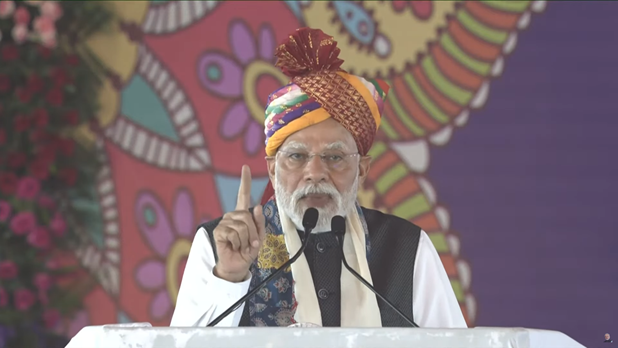
New Delhi: Speaking at the Hindustan Times Leadership Summit 2025, Prime Minister Narendra Modi presented an impassioned vision for India’s future — one rooted in reform, self-confidence, and freedom from what he described as the “mentality of slavery.”
Addressing an audience of distinguished guests from India and abroad, the Prime Minister commended Hindustan Times for its theme this year, “Transforming Tomorrow”, saying it captured the essence of India’s ongoing journey of change.
When an institution with over a century of history — one blessed by Mahatma Gandhi, Madan Mohan Malaviya and GD Birla — speaks of transformation, Modi said, “the nation gains the assurance that change in India is not just possible but already underway.”
The address coincided with the Mahaparinirvan Diwas of Dr Babasaheb Ambedkar, to whom the Prime Minister paid heartfelt tribute, acknowledging his role as the chief architect of India’s Constitution.
India: A Bright Spot in an Uncertain World
The Prime Minister began by reflecting on a turbulent 25 years of the 21st century — from global recessions and pandemics to wars and technological disruptions. Amid such uncertainty, he said, India stands out as a “pillar of confidence.”
“When the world talks of slowdown, India writes a story of growth. When trust is in crisis elsewhere, India emerges as a symbol of reliability. And when the world is fragmenting, India acts as a bridge-builder,” Modi remarked.
Recent GDP figures, he noted, demonstrate this resilience. India’s economy grew by over 8 percent in the second quarter of the current financial year, making it one of the fastest-growing major economies in the world — well above the global average of 3 percent and far ahead of most G7 nations, which hover around 1.5 percent.
“This is not just a number,” he emphasised, “but a strong signal that India is now the growth driver of the global economy.”
He attributed India’s economic performance to a combination of reforms, resilience and rising aspirations over the last decade — a transformation not just in statistics but in national mindset.
Reforms That Shape the Future
Modi described 2025 as a year of systemic reform. Among the most significant, he said, was the introduction of Next Generation GST, modernising the tax structure and simplifying compliance.
In a move aimed at empowering the middle class, the government also removed income tax on earnings up to ₹12 lakh, a reform that “a decade ago would have been unthinkable,” he said.
Further, the definition of Small Companies was revised to help thousands of enterprises benefit from simpler procedures and better facilities. Around 200 product categories were simultaneously removed from mandatory quality control orders — a step towards reducing red tape and promoting ease of business.
“These reforms are deliberate, not reactionary,” the PM stressed. “Earlier, we acted after crises. Now, we reform by design — with clear goals and a consistent ‘Nation First’ approach.”
Restoring Faith, Trust and Confidence
The Prime Minister also reflected on how distrust between government and citizens, a lingering remnant of colonial rule, had long hindered India’s progress. “Earlier, your own documents weren’t accepted unless stamped by a government officer. We changed that — self-attestation is now enough,” he reminded the audience.
Schemes like the Mudra Yojana, which has provided ₹37 lakh crore in guarantee-free loans, have helped break this cycle of doubt. Even street vendors, he said, now receive direct bank funding, fuelling local entrepreneurship and confidence.
He also spoke of a new nationwide drive to return unclaimed money — ₹78,000 crore lying idle in bank accounts, ₹14,000 crore with insurance companies, ₹9,000 crore in unpaid dividends, and ₹3,000 crore with mutual funds. Through special awareness camps across 500 districts, the government has already returned “thousands of crores” to rightful owners.
“This isn’t just about money,” Modi explained. “It’s about trust. The government is reaching out to people, not to take — but to give back.”
Reclaiming India’s Lost Confidence
A major part of the address focused on redefining India’s identity — and undoing the psychological impact of colonialism. The Prime Minister argued that the British had systematically eroded Indian self-belief by labelling native traditions, culture, and industries as inferior.
“They made us believe our attire was unprofessional, our festivals unscientific, our culture irrational,” he said. “That mentality of slavery shook our national confidence.”
Modi cited examples from history to illustrate this loss — once a global hub for shipbuilding and arms manufacturing, India was later made dependent on imports. Even in trade, he said, “the country which once dominated its seas now pays ₹6 lakh crore a year to foreign shipping companies.”
He called on the nation to rid itself of this “slave mindset” within the next decade, marking 2035 — 200 years since the introduction of Macaulay’s colonial education policy — as a symbolic target year for complete mental freedom.
The Power of Reform and Modernisation
The Prime Minister pointed to success stories that reflect India’s growing self-reliance:
- Defence production is being revitalised, shaking off decades of import dependence.
- The space sector has opened to private players like Skyroot, which now plans to manufacture one rocket per month.
- In energy, India is transforming. Solar capacity has risen from 3 gigawatts in 2014 to nearly 130 gigawatts today, including 22 GW from rooftop installations.
The PM Surya Ghar Muft Bijli Yojana, he said, enables citizens to directly participate in the clean energy revolution. Sharing an example from his parliamentary constituency Kashi, he revealed that 26,000 homes there now harness rooftop solar energy, generating three lakh units of power daily and saving residents around ₹5 crore a month — roughly ₹60 crore a year. The initiative alone eliminates 90,000 metric tonnes of carbon emissions annually, equivalent to planting over 4 million trees.
Similarly, India has pivoted from being 75 percent dependent on imported mobile phones before 2014 to becoming a major exporter today, thanks to sustained “Reform, Perform, Transform” efforts.
Beyond Development: Transformation of Thought
Modi concluded with a call for collective effort, urging every citizen to take part in what he termed a “psychological renaissance” — a movement to rebuild national confidence and reshape India’s destiny.
“The journey of transforming tomorrow,” he said, “belongs not just to policies or summits, but to the people. The trust of 140 crore Indians is our biggest asset.”
After a moment of humour — offering Hindustan Times free business ideas, joking about their Marwari roots — the Prime Minister ended his speech as warmly as he began:
“If you want a better tomorrow, you must make up your mind to do something good today. When the intent is right, the future will be bright.”