


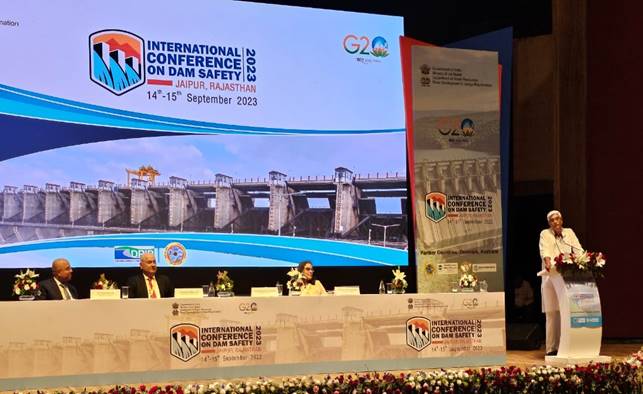
Jaipur: The International Conference on Dam Safety (ICDS) organised by the Department of Water Resources, River Development & Ganga Rejuvenation, Ministry of Jal Shakti concluded at Rajasthan International Centre (RIC) in Jaipur on Friday.
The conference’s closing session was presided over by Union Minister of Jal Shakti, Gajendra Singh Shekhawat. In his address to the esteemed audience, the Union Minister emphasized the importance of dam health and safety, foreseeing it as a crucial aspect of future dam management. He expressed his gratitude to all participants and expressed confidence that the outcomes of ICDS 2023 would significantly contribute to ensuring the safety and longevity of critical dam infrastructure.
Shekhawat proposed several actionable points, including the establishment of a joint action force in collaboration with the National Institute of Disaster Management (NIDM) to advance Emergency Action Plans (EAPs) for dams. He also suggested creating a compendium after analyzing design flaws identified in Dam Safety Reviews and developing a comprehensive strategy that integrates the conference’s deliberations and outcomes for implementation. Additionally, he recommended organizing workshops to discuss dam safety incidents and failures, with outcomes disseminated to all dam-owning agencies and stakeholders to prevent future incidents.
During the two-day conference, various technical sessions were held to empower experts and leaders in the field to enhance dam safety. Anand Mohan, Joint Secretary of the Department of Water Resources, River Development & Ganga Rejuvenation (DoWR, RD & GR), summarized the conference’s outcomes and shared the recommendations that emerged from the sessions.
Several presentations were delivered during plenary sessions, covering topics such as Government of India Initiatives on Dam Safety and Management, the Dam Safety Status of Maharashtra, Regulating Dam Safety in New South Wales (NSW), Collaboration between Denmark & India on Water Management, Collaboration between Australia & India on Water Management, and World Bank Initiatives on Dam Management.
The second part of the day featured a technical session on “International & National Practices in Dam Safety Management & Governance,” with presentations on Dam Safety in the United States, NSW Dams Safety Regulation Framework, Best Practices for Dam Safety Management, Opportunities for Stakeholders in compliance with the Dam Safety Act, 2021, and Dam Safety Management Practices at Tehri Dam.
Simultaneously, an industrial session focused on “Dam Health Assessment” and covered topics like Automated Detection and Estimation of Dam Volume, Bridging Technology and Safety, Geophysics for Dam Health Assessment, Identification of Weak Zones, Instrumentation for Dam Safety, Dam Safety and Health Assessment Practices in NHPC, and Seismic Tomography at Baglihar Dam.
On September 15, 2023, the second day of the conference commenced with a technical session on “Best Practices in Dam Rehabilitation,” featuring topics such as Dam Rehabilitation Initiatives and Dam Safety Best Practice Note of the World Bank, Underwater Pointing and Grouting of Krishnarajasagar Dam, Curtain Grouting & Cut-Off Trench at Joshiyara Barrage, and Seepage Control Measures using Cementitious Grouting of Masonry Gravity Dams.
Concurrently, another technical session addressed Reservoir Sediment Management, Knowledge Products for Sediment Management Analyses, Holistic Sediment Management in Reservoirs, Sediment Management Practices in Dhauliganga Power Station, Satellite-Derived Bathymetry, Sedimentation in Reservoirs, and the International Centre of Excellence for Dams (ICED).
The second half of the day featured a Technical Session on “Operation, Maintenance & Emergency Management,” covering topics related to Dam Operation & Maintenance in New South Wales, Reservoir Operational Guidance, Inflow Forecasting for Tehri Dam, AIoT Technologies for Dam Emergency Prediction, GLOF Study in Chenab Basin, and Reservoir Dredging.
Simultaneously, another Technical Session addressed “Lessons from Dam Failures & Dam Incidents,” featuring topics such as Liquefaction Analysis of Chang Dam, Failure of Karam Dam, Dam Break Analysis of Annamayya Dam, Geotechnical Investigation of Sink Holes at Anaikuttam Dam, Seismicity and Dams, and Parambikulam Dam Shutter Failure and Management.
In a subsequent technical session, the focus turned to “Risk Assessment” in dam safety and risk management, covering topics like Beyond Standards for Dam Safety, Integrated Risk Management, Risk Assessment Framework for Indian Dams, Comprehensive Risk Assessment of Maithon Dam, Seismic Safety Assessment of Sholayar Dam, Earthquake Risk Estimation of Dams, and Sensitivity Analysis in PMF Estimate of Large Catchments.
The presentations in this session highlighted cutting-edge methodologies and insights in risk assessment, promoting a proactive approach to ensure the safety and integrity of dams. These discussions showcased global perspectives and innovative strategies for addressing dam safety challenges.
In the industrial session titled “Dam Rehabilitation Techniques and Materials,” experts shared groundbreaking insights and advancements in dam rehabilitation. Topics included Laboratory Studies for Design of Cementitious Grout Mix for Seepage Reduction, Underwater Repair and Rehabilitation of Dams, Usage of Synthetic Geomembranes for Waterproofing in Dams, Rehabilitation of Sardar Sarovar Dam with Sika System, Assessment of Repair Materials for Damaged Spillways, Sediment and Floating Materials Management in Dam Safety, and Monitoring Dam Health and Safety.