


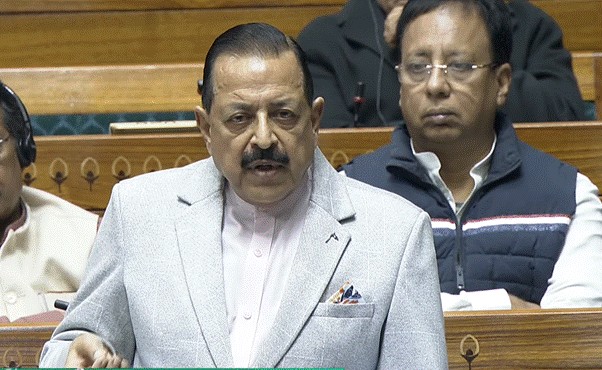
New Delhi: Union Minister of Science and Technology, Dr. Jitendra Singh, has said that the Sustainable Harnessing and Advancement of Nuclear Energy for Transforming India (SHANTI) Bill, 2025, offers a balanced approach to safety, accountability, and innovation in India’s growing nuclear energy sector.
Addressing the Lok Sabha during a detailed debate on the Bill, Dr. Singh assured Members of Parliament that the proposed legislation aims to modernise India’s six-decade-old nuclear framework while retaining the strong safety and liability protection long established under the Atomic Energy Act of 1962.
“The SHANTI Bill is about bringing India’s nuclear governance in line with today’s technological and energy needs,” Dr. Singh told the House. “It strengthens our systems, not weakens them.”
Giving the Regulator Statutory Status
One of the key changes, the Minister explained, is the granting of statutory status to the Atomic Energy Regulatory Board (AERB). Until now, the AERB functioned under an executive order, but under the new law it will become a fully-fledged statutory regulatory body with defined powers and responsibilities.
Dr. Singh emphasised that even with scope for private sector participation, the government will continue to exercise full control over sensitive nuclear materials such as fissile substances, used fuel, and heavy water. Regular inspections, safety audits, and strict security checks will remain central to the system.
He clarified that private companies will not have access to or control over any sensitive materials. “Spent fuel management will continue to be handled by the government, as it always has been,” he said.
New Approach to Liability and Compensation
A major point of discussion during the debate was liability—how responsibility and compensation will be managed in case of a nuclear incident.
Dr. Singh said the new framework does not water down the rights of victims. Instead, it brings in a more practical structure based on global standards. Under the SHANTI Bill, operator liability will follow graded caps linked to the size and capacity of reactors. This, the Minister explained, is designed to encourage investment in newer technologies such as small modular reactors, while ensuring that adequate compensation remains available through a multi-layered system.
This structure includes three safety nets: operator liability, a government-backed Nuclear Liability Fund, and access to international compensation mechanisms through India’s membership in the Convention on Supplementary Compensation.
Dr. Singh also noted that supplier liability—once seen as a barrier to growth—has been revised in line with international practices and improvements in reactor design and safety. However, he reassured Parliament that negligence and penalties for violations will remain firmly enforceable.
Supporting Growth Without Weakening Oversight
Rejecting concerns that the Bill undermines the public sector, Dr. Singh pointed to a 170 per cent increase in the Department of Atomic Energy’s budget over the past decade and a doubling of installed nuclear power capacity since 2014.
Despite this growth, he said nuclear energy still makes up only a modest portion of India’s total power generation compared with global levels. Expanding this proportion, he argued, is critical to meeting India’s clean energy commitment for 2047, especially as demand from sectors like healthcare, data processing, and manufacturing continues to rise.
According to the Minister, the Bill creates space for responsible private and joint venture participation aimed at mobilising resources, reducing project delays, and helping the country achieve its goal of 100 gigawatts of nuclear capacity by 2047.
Broadening the Scope of Nuclear Energy
The Minister also highlighted that the SHANTI Bill moves beyond power generation, recognising nuclear technology’s role in medicine, agriculture, and industry. For the first time, the law will include environmental and economic damage in its definition of nuclear harm—marking a broader and more responsible understanding of nuclear impacts.
Dr. Singh said dedicated investments for small modular reactor projects, research, and innovation are already being lined up. He called the Bill a “forward-looking step” that balances safety, advancement, and sustainability.
“As India approaches 100 years of Independence,” he said, “the SHANTI Bill is a pledge to harness clean, reliable atomic energy while keeping public trust and safety at its heart.”