


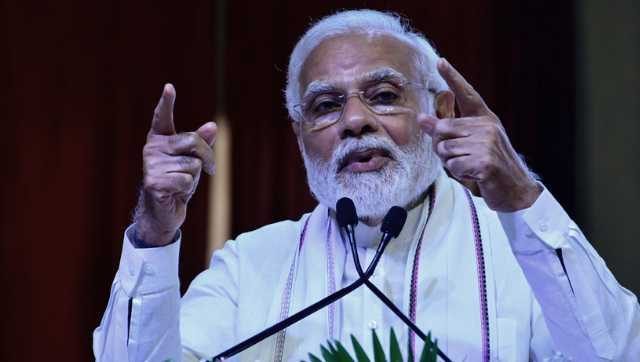
Hansalpur, Gujarat: In a landmark development for India’s green mobility mission, Prime Minister Narendra Modi inaugurated a suite of green mobility initiatives at the Suzuki Motor Corporation’s Hansalpur plant in Gujarat. Marking a major stride in the “Make in India, Make for the World” campaign, India will now export electric vehicles (EVs) to 100 countries, while also commencing domestic manufacturing of hybrid battery electrodes.
Speaking at the event, Prime Minister Modi highlighted this milestone as a “new chapter” in India’s self-reliance journey. “From today, Electric Vehicles made in Bharat will be exported to 100 countries,” he announced. The launch also witnessed the beginning of hybrid battery electrode manufacturing at the site, with the PM noting it as a significant boost to India’s localisation and clean energy efforts.
The ceremony was attended by Gujarat Chief Minister Bhupendrabhai Patel, Japan’s Ambassador to India Keiichi Ono, President of Suzuki Motor Corporation Toshihiro Suzuki, and Maruti Suzuki India Managing Director Hisashi Takeuchi, along with hundreds of plant employees.
Recalling the foundation laid in 2012 during his tenure as Gujarat Chief Minister, Modi attributed the current success to the long-term vision of building an Atmanirbhar Bharat (self-reliant India). He paid tribute to the late Osamu Suzuki, lauding his role in shaping Maruti-Suzuki India’s journey.
The Prime Minister emphasised the mutual trust between India and Japan, pointing out that Suzuki Japan is now manufacturing in India and exporting cars back to Japan. He described companies like Maruti Suzuki as “brand ambassadors of Make in India,” underscoring Maruti’s status as India’s top car exporter for four consecutive years.
In a nod to India’s technological progress, Modi noted the launch of battery cell production through a joint initiative involving three Japanese companies at the TDSG plant, established in 2017. “Even the electrodes for battery cells will now be produced locally in Bharat,” he stated, heralding a new era for India’s EV and hybrid vehicle industries.
Demonstrating innovation in healthcare mobility, the Prime Minister unveiled a prototype hybrid ambulance developed by Maruti Suzuki within six months. It forms part of the government’s ₹11,000 crore PM E-DRIVE scheme, which allocates funds for e-ambulances. “Hybrid EVs will reduce pollution and also provide an option to transform old vehicles,” he said.
Modi reaffirmed India’s commitment to clean energy and industrial self-sufficiency. He cited exponential growth in manufacturing, including a 500% rise in electronics production and a 2,700% increase in mobile phone manufacturing since 2014. Defence manufacturing had also seen more than 200% growth.
The Prime Minister encouraged all Indian states to adopt pro-development policies and compete in reforms to attract global investment. “There should be such clear cut competition, the country will benefit from this,” he asserted, calling for cooperative federalism in industrial progress.
Looking ahead, Modi outlined plans to advance into futuristic industries, including the semiconductor sector where six plants are nearing completion. He also addressed the shortage of rare earth magnets and the launch of the National Critical Mineral Mission, which will undertake over 1,200 exploration expeditions to source vital minerals domestically.
Highlighting Indo-Japanese relations, the Prime Minister reflected on two decades of bilateral cooperation, starting with the 2003 Vibrant Gujarat Summit. He praised the cultural and personal ties developed between Gujarat and Japan, citing efforts to make Japanese professionals feel at home by introducing Japanese cuisine, golf courses, and language education in Gujarat.
“The journey we started with Maruti Suzuki has now reached the speed of a bullet train,” Modi said, expressing confidence in the enduring partnership between the two nations. He concluded with a passionate appeal for Swadeshi (local production), asserting, “It doesn’t matter whose money is invested… What matters is that in production, the sweat belongs to my countrymen.”
The Prime Minister urged citizens to take pride in local manufacturing and contribute to building a developed India by 2047. “By 2047 we will surely build a ‘Viksit Bharat’. Bharat will continue to increase its contribution to the welfare of the world,” he declared.