


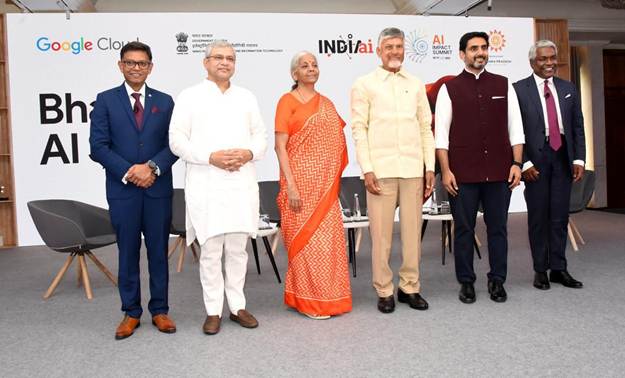
New Delhi: In a major leap toward transforming India into a global artificial intelligence (AI) powerhouse, Union Minister for Electronics and Information Technology, Ashwini Vaishnaw, has hailed Google’s announcement of its USD 15 billion AI Hub in Visakhapatnam as a landmark step that will “redefine India’s digital economy.”
Speaking at Bharat AI Shakti, an event hosted by Google ahead of the upcoming India AI Summit, Vaishnaw described the project as “a game-changer that ushers in a new era for India’s AI-first infrastructure.” He emphasised that the initiative aligns perfectly with the Government of India’s Viksit Bharat Vision, and will accelerate the nation’s progress in building a robust AI-driven ecosystem powered by clean energy and cutting-edge data infrastructure.
“This infrastructure breaks new ground in the realm of AI-first data centre architecture, anchored by investments in subsea cable networks and clean energy,” Vaishnaw said. “It will not only fuel a new era of AI-driven services but also create high-value jobs and economic opportunities across the country.”
Building India’s AI Backbone
Google’s AI Hub in Visakhapatnam will feature a purpose-built data centre campus that adds gigawatt-scale compute capacity to India’s rapidly growing digital infrastructure. With a total investment of USD 15 billion spread over five years (2026–2030), this is Google’s largest investment in India to date.
The Hub will enable Google to deploy its full AI stack—spanning infrastructure, research, and applications—aimed at empowering businesses, startups, and developers to innovate at scale. The centre will also host advanced AI capabilities built on Tensor Processing Units (TPUs), Google’s proprietary hardware that rivals Nvidia’s GPU-based systems, and will be a cornerstone of the India AI Mission.
The Minister urged Google to leverage the new facility to promote reskilling and upskilling of IT professionals, ensuring India’s workforce is prepared for an AI-led future. “We need a massive reskilling revolution,” he said. “Google can play a pivotal role in supporting this industry-wide transformation.”
Connectivity: Linking India to the World
In a forward-looking proposal, Vaishnaw announced plans to develop a Vizag–Sittwe (Myanmar) digital corridor, aimed at boosting connectivity in India’s North-Eastern states. The proposed extension of the RailTel network and cross-border cable through Myanmar to Mizoram will, he said, “be a major step in integrating the North-East with India’s high-speed digital backbone.”
Further highlighting India’s strategic position in global connectivity, Vaishnaw called for developing the Andaman and Nicobar Islands as a next-generation hub for global internet data transfer.
“Singapore is already overburdened,” he remarked. “Why can’t we make Andaman the next major hub for global data? The Government of India will provide full support for this initiative.”
The new international subsea gateway planned as part of the Google AI Hub will connect Visakhapatnam with Google’s global fibre network spanning over two million miles, creating fresh routes for digital traffic and reducing latency. This will complement existing subsea cable landings in Mumbai and Chennai, improving India’s overall digital resilience and enabling faster, more reliable data flows.
Energy Efficiency and Sustainability at the Core
One of the most significant aspects of the project is its commitment to sustainability. Google has pledged to work with partners in Andhra Pradesh to deliver clean energy generation, transmission infrastructure, and storage systems. The company’s data centres are among the most energy-efficient in the world, and this project is expected to enhance the resilience of India’s electricity grid while supporting the transition to renewable energy.
Voices from the Leadership
Andhra Pradesh Chief Minister, N. Chandrababu Naidu, called the development “a historic milestone” for both the state and the nation.
“This investment marks a new chapter in India’s digital transformation journey,” Naidu said. “We are proud to host India’s first truly gigawatt-scale data centre and Google’s first AI Hub in India. It reinforces our shared commitment to innovation, AI adoption, and long-term support for startups and enterprises in the state.”
From the corporate front, Thomas Kurian, CEO of Google Cloud, said, “The Google AI Hub in Visakhapatnam represents a landmark investment in India’s digital future. By delivering world-class AI infrastructure at scale, we are enabling businesses to innovate faster and creating meaningful opportunities for inclusive growth. This partnership reflects our shared commitment with the Indian and U.S. governments to harness AI responsibly and drive transformative societal impact.”
Empowering the AI Ecosystem
Once operational, the AI Hub will become part of Google’s global network of data centres across 12 countries. It will draw on expertise from Google’s R&D teams in Bengaluru, Hyderabad, and Pune, integrating advancements in AI software, hardware, and energy-efficient data management.
The hub is also expected to support India’s growing digital businesses—from large enterprises like TCS, MakeMyTrip, and Meesho to emerging AI startups such as CoRover, Glance, InVideo AI, and Sarvam AI. It will provide low-latency, high-performance compute power, helping these organisations build scalable AI-powered applications, enhance R&D, and innovate across sectors including healthcare, agriculture, finance, and education.
A New Era for Digital India
The Visakhapatnam AI Hub stands as a cornerstone of India’s ambition to become a global AI innovation hub. With this strategic investment, India is positioning itself not just as a consumer of global technology but as a producer of next-generation AI capabilities.
As Vaishnaw succinctly put it, “This is not just about infrastructure—it’s about shaping the future of India’s economy. The Google AI Hub is a statement of confidence in India’s talent, technology, and transformative potential.”
In a world increasingly driven by artificial intelligence, this collaboration between the Government of India and Google is poised to propel the country toward a smarter, more connected, and sustainable digital future.