


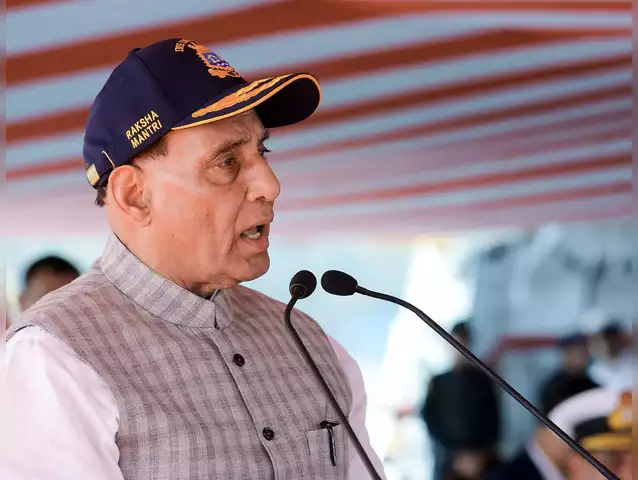
New Delhi: “Indian ethos do not see global order as a contest for dominance, but as a shared journey towards harmony, dignity and mutual respect for all,” said Raksha Mantri Rajnath Singh at the World Leaders Forum in New Delhi on 22 August 2025.
He emphasised that, in India’s tradition, strength is measured not by the ability to command but by the capacity to care. True power, he said, lies not in pursuing narrow interests but in committing to the global good. Singh underlined India’s growing leadership in shaping a fair international order, supported by major advances in the defence sector.
Referring to Pakistan’s Army Chief, who compared India’s economy to a sports car and Pakistan’s to a dump truck, Singh said this was not mere trolling but an admission. He stressed that while both countries gained independence together, India’s progress was the result of vision, policy and hard work, whereas Pakistan’s failures were of its own making.
The Raksha Mantri asserted that India’s prosperity must go hand in hand with national honour and defence capability. Citing Operation Sindoor, he reaffirmed that no one should be under any illusion about India’s strength.
He highlighted that defence exports had risen nearly 35-fold over the past decade, from just ₹686 crore in 2013-14 to ₹23,622 crore in 2024-25. Indian defence products now reach almost 100 countries. The government has set a target of ₹30,000 crore in exports this year and ₹50,000 crore by 2029.
Domestic defence production, Singh noted, had more than tripled in the last ten years—from ₹40,000 crore in 2014 to over ₹1.5 lakh crore in 2024-25—and is expected to approach ₹2 lakh crore in the current fiscal.
He underlined that India has released five positive indigenisation lists covering 509 platforms, systems and weapons that must now be manufactured domestically. Defence Public Sector Undertakings have issued their own lists, covering over 5,000 key sub-systems, spares and components. In addition, 75% of the defence capital procurement budget has been reserved for Indian companies.
“Our vision of Aatmanirbharta in defence is not only about reducing imports,” Singh explained. “It is about building an ecosystem where Indian industry—public and private—creates world-class capability to serve both domestic needs and global markets.”
Highlighting recent milestones, Singh pointed to Hindustan Aeronautics Limited (HAL) receiving orders worth ₹66,000 crore for 97 Tejas fighter jets, alongside an earlier ₹48,000 crore order for 83 jets. He said Tejas would become a shining example of India’s indigenous strength, with steps already underway to develop fifth-generation fighter aircraft and engines domestically.
The Raksha Mantri spoke of the defence industrial corridors in Uttar Pradesh and Tamil Nadu, which are drawing major investments and driving sectoral growth. He said the Strategic Partnership model had opened opportunities for Indian firms to manufacture fighter jets, helicopters, tanks and submarines. The iDEX initiative was nurturing startups and MSMEs, while FDI reforms now allow up to 74% investment under the automatic route and 100% with government approval.
He also underlined the government’s decision to provide Transfer of Technology from DRDO free of cost, further boosting private innovation.
Rajnath Singh pointed out that India’s defence budget had risen sharply, from ₹2.53 lakh crore in 2013-14 to nearly ₹6.22 lakh crore in 2024-25, with further increases following Operation Sindoor. He stressed that strengthening defence has been central to Prime Minister Narendra Modi’s vision of uninterrupted national development.
Extending an invitation to global defence firms, Singh cited Airbus’s partnership with Tata Aerospace to produce C295 transport aircraft in India. “This is not just Make in India,” he said. “When you make in India, you make for the world.”
Singh expressed his conviction that India is destined to play a leading role in shaping the new world order, based on three pillars: its civilisational values, rapid economic rise, and powerful demographic dividend.
He explained that India’s ethos of Vasudhaiva Kutumbakam—the world is one family—provides a moral foundation for a just, inclusive and sustainable order. Economically, he noted, India has emerged as the world’s fastest-growing economy, now the fourth largest and advancing towards third place. Exports have risen by 76% over the past decade, while domestic demand has remained resilient.
Finally, Singh described India’s youth as its greatest asset. With 65% of the population below the age of 35, and the country now hosting over 100 unicorns in the world’s third-largest startup ecosystem, India’s demographic strength is poised to shape its global leadership.