


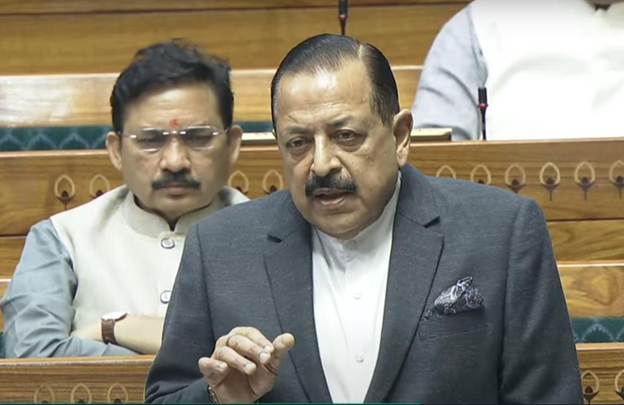
New Delhi: India’s nuclear programme has reached a defining milestone that, according to Union Minister of State in the Prime Minister’s Office, Dr Jitendra Singh, truly vindicates Dr Homi Bhabha’s original pledge to the world—that India’s nuclear journey would be anchored in peaceful and people-centric applications. Speaking on Wednesday, the Minister said this commitment has found its “strongest realisation” under Prime Minister Narendra Modi, with nuclear science now delivering tangible benefits in healthcare, agriculture, water purification, and several other sectors that directly impact citizens’ lives.
Dr Singh recalled that when India took its first steps in nuclear research decades ago, global powers raised serious doubts about the country’s intentions. “Today, the success of peaceful applications—whether in cancer care through Tata Memorial Centre’s expanding network, or in community-level water purification—proves India has always remained responsible in its approach,” he said.
He highlighted India’s rapid advancement in nuclear-linked healthcare. A total of 11 Tata Memorial cancer hospitals have now been set up across the country, with nine already functional. Additionally, the National Cancer Grid, powered by sophisticated diagnostics and digital infrastructure, connects more than 300 hospitals, ensuring standardised, high-quality cancer treatment nationwide.
One of the most significant reforms, Dr Singh noted, is the Modi Government’s decision to open parts of the nuclear sector to private participation for the first time. Through a PPP model, nearly 40 private players are now working alongside the Department of Atomic Energy on water purification technologies. This collaboration is aimed at expanding access to clean drinking water and improving public health outcomes—a step the Minister described as “a major push towards a healthier, safer, and more empowered India.”
The Minister’s remarks came during Question Hour in the Winter Session of Parliament. Malvika Devi, MP from Kalahandi in Odisha, raised concerns over recurring kidney-related ailments in Nuapada district, caused largely by contaminated water. She asked about the impact of installing 500 reverse osmosis (RO) purification systems and whether there has been any improvement in health indicators.
Responding, Dr Singh said Odisha has emerged as a national model for the successful use of nuclear-backed water purification solutions. In Kalahandi alone, all 500 RO-based units, installed with support from the Department of Atomic Energy, are providing clean and safe drinking water by removing salinity and harmful chemicals. He added that ultrafiltration systems—designed to eliminate microbes and pathogens—have also been deployed in the most affected regions. Similar community-level water purification units are currently operational in Khordha, Mayurbhanj, and Boudh.
Dr Singh stressed that the Government’s approach is non-discriminatory and entirely based on public need. He reaffirmed that installations of nuclear-supported purification systems have been carried out in multiple states, including West Bengal, Bihar, Chhattisgarh, Maharashtra, Gujarat, Rajasthan, Tamil Nadu, Kerala, Assam, and Karnataka—regardless of which political party governs them.
Quoting Prime Minister Modi’s repeated emphasis on citizen welfare, Dr Singh said, “Safeguarding every citizen’s health is the Government’s foremost responsibility.”
He concluded by stating that India’s nuclear programme—rooted from day one in peaceful objectives—is now emerging as a robust driver of national development, touching lives in some of the country’s most remote and vulnerable communities.