


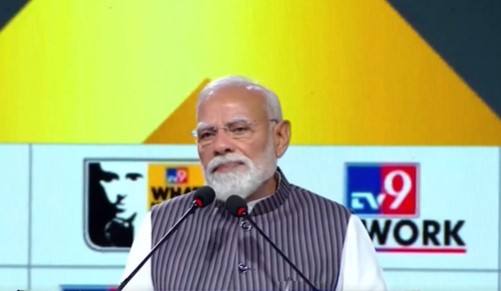
New Delhi: At a time when the world is grappling with rising conflicts and uncertainty, Prime Minister Narendra Modi on Monday said India continues to move forward with confidence, resilience, and a clear focus on national interest, balancing global challenges with steady domestic progress.
Speaking at the TV9 Summit 2026, Modi reflected on the evolving global situation, describing it as serious and unprecedented. He noted that tensions and conflicts across regions have created a complex environment, making discussions around “India and the World” both timely and important.
He observed that India today is no longer a country that avoids challenges. Instead, it confronts them head-on with determination. Over the past few years, especially after the pandemic, the country has faced continuous tests. Yet, through the collective efforts of its 1.4 billion citizens, India has managed to overcome these challenges and maintain its growth trajectory.
The Prime Minister pointed out that India’s approach during global crises has drawn global attention. In recent weeks, particularly since the turmoil that began on February 28, India has demonstrated its strength in decision-making, crisis management, and maintaining international relationships. Despite difficult conditions, the country has remained focused on progress and development.
Highlighting India’s diplomatic stance, Modi said the country has built bridges across regions — from the Gulf to Western nations, and from developing countries to its neighbours. Addressing questions about alignment in global conflicts, he made it clear that India stands firmly for its own interests, while also supporting peace and dialogue.
On the economic front, he said India has worked to shield its citizens from global disruptions. Efforts have been made to maintain stability in supply chains, particularly in key sectors such as energy, fertilisers, and essential goods, ensuring minimal hardship for people.
The Prime Minister also referred to past economic decisions, particularly between 2004 and 2010, when oil bonds worth ₹1.48 lakh crore were issued. He said this move placed a long-term financial burden on the country, which later rose to over ₹3 lakh crore due to interest. According to him, the government has had to address these liabilities over the past several years.
Turning to the ongoing global conflicts, including those in West Asia, Modi stressed that even distant wars have an impact on interconnected economies like India. In such times, he called for restraint and unity, urging citizens to rise above political differences and work together, much like during the pandemic.
Despite global uncertainties, he highlighted that India’s development momentum remains strong. In just 23 days since the recent conflict began, projects worth thousands of crores have been initiated or completed across the country. These include metro expansions in Delhi, a high-speed corridor in Silchar, a new airport in Kota, and international status for Madurai Airport.
He also mentioned key decisions taken in the past month, such as the approval of 100 industrial parks, expansion of hydro power capacity by 1,500 megawatts, and the extension of the Jal Jeevan Mission till 2028. Additionally, over ₹18,000 crore has been transferred directly to farmers under the PM Kisan Samman Nidhi, while MSMEs and exporters have received relief worth around ₹500 crore.
Explaining the government’s approach, Modi referred to a management principle — “What gets measured, gets managed” — adding that measurement also leads to improvement and transformation. He said this philosophy has played a key role in driving progress across sectors over the past decade.
Citing examples, he said highway construction has increased from 11–12 kilometres per day earlier to nearly 30 kilometres per day now. Port turnaround time has reduced from 5–6 days to less than 2 days. The number of startups has grown from around 500 before 2014 to over 200,000 today. Similarly, MBBS seats have more than doubled, bank accounts have crossed 550 million, and the number of airports has increased from less than 70 to over 160.
The Prime Minister also spoke about efforts to address regional imbalances in development, particularly in eastern India. He highlighted industrial growth in Assam and Odisha, infrastructure expansion in Bihar, and manufacturing progress in Uttar Pradesh as examples of changing ground realities.
At the same time, he cautioned against political approaches that, in his view, hinder development. He emphasised that while opposition is an essential part of democracy, it should not come at the cost of national progress or the country’s global image.
Concluding his address, Modi invoked the sacrifices of Bhagat Singh, Rajguru, and Sukhdev, along with the ideals of Ram Manohar Lohia, to stress the importance of placing national interest above personal or political considerations. He expressed confidence that this spirit would help India move towards becoming a developed and self-reliant nation.