


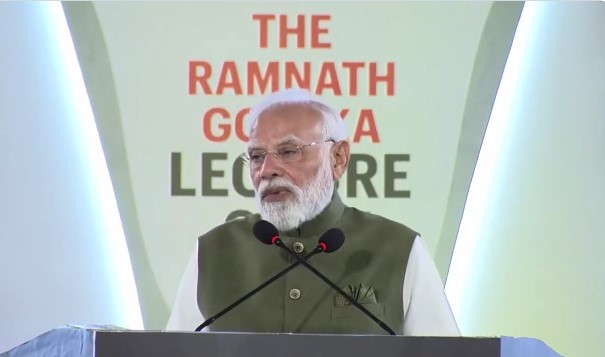
New Delhi: Prime Minister Narendra Modi delivered a stirring address at the sixth Ramnath Goenka Lecture in New Delhi, paying tribute to the late Ramnath Goenka, founder of The Indian Express Group, and calling for a collective national effort to free India from what he termed the “mindset of slavery” inherited from colonial rule. The event, attended by media leaders, diplomats, and dignitaries, highlighted the importance of fearless journalism, democratic participation, and inclusive growth.
Speaking about Goenka’s legacy, the Prime Minister said the veteran journalist was not just a media leader but “an institution in himself,” whose life was driven by courage, nationalism, and an unwavering commitment to truth. Modi noted that Goenka’s work transformed The Indian Express from a newspaper into “a mission among the people of Bharat,” championing democratic values and national interests.
Quoting a verse from the Bhagavad Gita, the Prime Minister reflected on Goenka’s philosophy of duty over fear or favour. He recalled several defining moments of Goenka’s life, including his stand during the Emergency and his support for the freedom movement and later democratic causes. “Ramnath ji always stood by the truth, regardless of how powerful the forces against him were,” Modi said.
Bharat’s Journey of Resilience
The Prime Minister drew parallels between Goenka’s impatience for change and India’s current determination to grow. “Today’s Bharat is impatient to become developed and self-reliant,” he remarked, pointing out that despite global crises—from the pandemic to geopolitical conflicts—India’s economy remained resilient. “Even as the world faces instability, Bharat’s growth rate remains close to seven percent,” he said, calling India not just an emerging market but “an emerging model” for the world.
He stressed that India’s democratic strength lay in the active participation of its people, citing Bihar’s record voter turnout—particularly among women—as evidence of growing public faith in democracy. “This is a victory of democracy,” he said, urging all state governments, irrespective of ideology, to focus solely on “development, development, and only development.”
Development as the Core Political Mandate
Modi emphasised that political success must be tied to emotional commitment and not merely electoral strategy. “To win elections, one need not stay in election mode 24×7; one must remain in emotional mode 24×7,” he explained. “When there is restlessness within the heart to serve, that emotion drives results.”
He lauded BJP workers across the country for their dedication, some of whom, he noted, had sacrificed their lives in states like Kerala, West Bengal, and Jammu & Kashmir. Their goal, he said, was not only to win elections but to win people’s trust.
True Social Justice and the Reach of Welfare
Highlighting the government’s social welfare record, Modi said true social justice means ensuring that the benefits of development reach every section of society. “In the last eleven years, nearly 94 crore people in Bharat have come under the social security net—up from just 25 crore a decade ago,” he noted.
He cited landmark initiatives such as the construction of 12 crore toilets, the opening of 57 crore Jan Dhan bank accounts, and the building of 4 crore pucca houses as examples of empowerment and dignity for the poor. “This is what real social justice looks like,” he said. “Because when every eligible citizen receives benefits, discrimination ends—and that is when democracy truly delivers.”
From Backward to Aspirational
The Prime Minister spoke about the transformation of India’s “Aspirational Districts”—areas once written off as “backward” by previous governments. “Over 25 crore people live in these districts,” he said, noting that the new approach of deploying capable officers, engaging state governments, and setting measurable goals had brought remarkable improvements. Referring to Bastar in Chhattisgarh, once known for Maoist violence, he said, “Today, Bastar is progressing, its youth are hosting events like the Bastar Olympics—something that would have made Ramnath ji proud.”
Critique of the Opposition
Modi also launched a sharp critique of the Congress party, accusing it of nurturing Maoist and “urban Naxal” elements. He claimed that the party had transformed into what he called the “Muslim League–Maoist Congress,” driven by selfish motives and a disregard for national unity. “Today’s Congress has become a threat to the unity of the country,” he said.
Reclaiming India’s Intellectual Independence
Turning to the theme of “mental decolonisation,” the Prime Minister reflected on the long-lasting effects of Lord Macaulay’s education policies from 1835, which, he said, “destroyed Bharat’s self-confidence and uprooted its indigenous education system.” He lamented that even after Independence, India continued to look abroad for validation in education, governance, and innovation.
“It’s time to end Macaulay’s mindset,” he declared, urging citizens to take a national pledge to free India from this colonial mentality by 2035, marking 200 years since Macaulay’s reforms. “Just as Gandhi ji wished to lock a leprosy hospital when the disease was eradicated, it is my dream that we lock this mindset forever,” he said.
He underscored the importance of promoting local languages, drawing examples from Japan, China, and Korea, which embraced modernisation without abandoning their linguistic identity. “We are not against English; we are for Indian languages,” he clarified, referencing the National Education Policy’s focus on mother tongue-based education.
Conclusion
Closing his speech, the Prime Minister hailed The Indian Express Group as a vital witness to India’s transformation journey. “As Bharat moves forward towards the goal of becoming a Viksit Bharat—a developed India—it is heartening to see The Indian Express once again playing a crucial role,” he said, congratulating the organisation for upholding Ramnath Goenka’s ideals.
“With respect to Ramnath Goenka ji, I conclude by saying that his spirit of truth, courage, and nationalism continues to guide us in building the Bharat of tomorrow,” he added, receiving a standing ovation from the audience.