


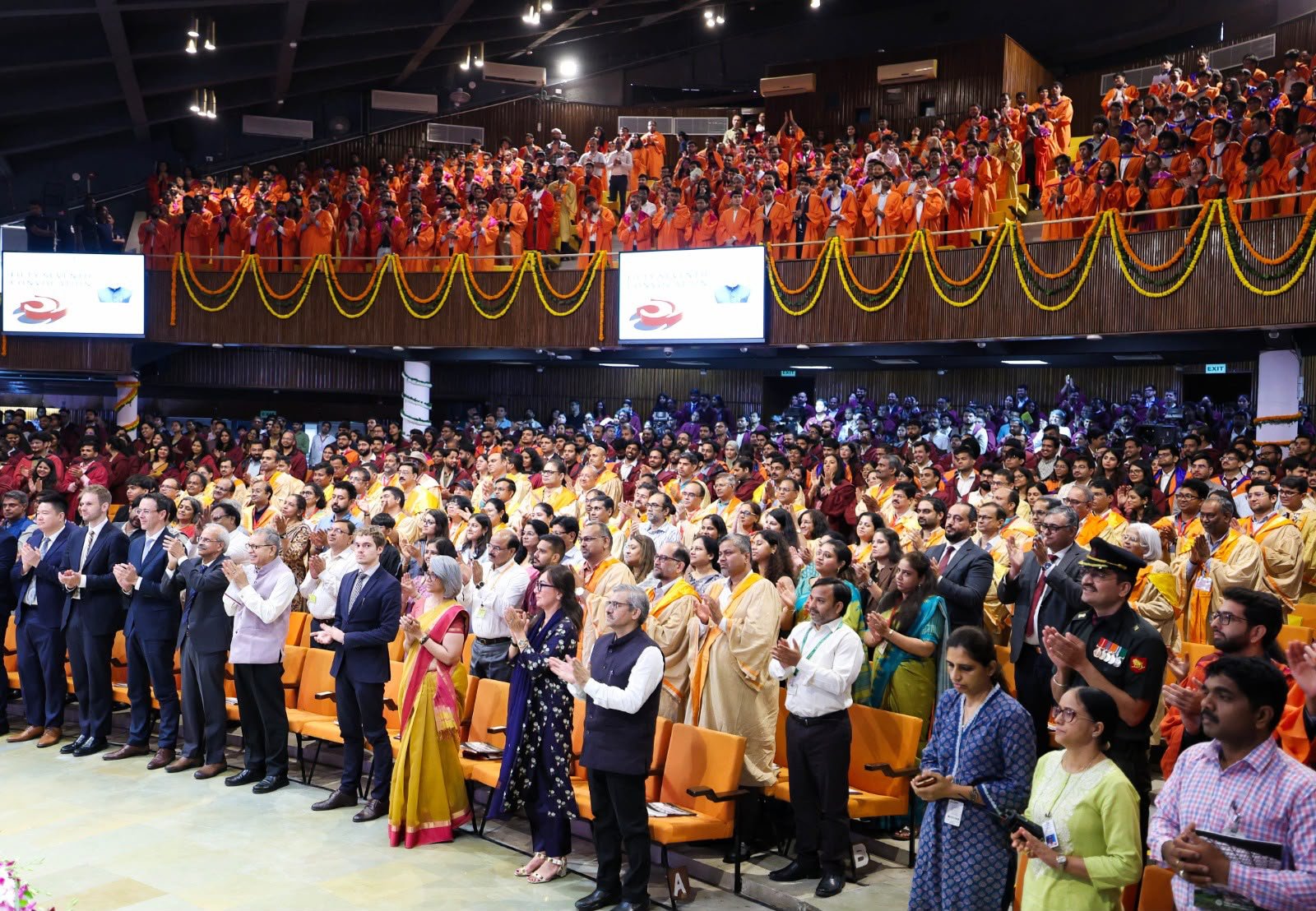
New Delhi: Prime Minister Narendra Modi has urged IIT Delhi graduates to keep learning, solve difficult problems and use their skills to support India’s development.
Addressing the 57th Convocation Ceremony of IIT Delhi on Saturday, the Prime Minister said students were entering professional life at a time of rapid technological and global change.
He told the graduating students that their degrees represented more than academic success, marks or job placements. Their education, he said, had trained them to face complex challenges, find practical answers and continue working when solutions were not immediately visible.
The ceremony was attended by Union Education Minister Prahlad Joshi, senior advocate Harish Salve, Professor Abhay Karandikar, IIT Delhi Director Professor Rangan Banerjee, faculty members, students, families and other guests.
A new chapter begins for IIT Delhi graduates
The Prime Minister said convocation marked the beginning of a new journey for the graduating students.
Some students, he noted, would soon receive their first salaries. Others might move to new cities, prepare for competitive examinations or begin work on their first start-ups.
He asked students to fully experience the emotions of the day before becoming occupied with larger responsibilities.
Recalling his previous IIT Delhi convocation address during the Covid period, which he attended virtually, the Prime Minister said he was pleased to be present on the campus this time.
He congratulated the students who received medals and also called for greater representation of women among the award winners.
New artificial intelligence initiatives were also launched at IIT Delhi during the event.
Students asked to value campus relationships
The Prime Minister spoke about the memories students had built during their years at IIT Delhi.
He referred to the institute’s hostels, including Kumaon, Aravali, Karakoram, Vindhyachal, Nilgiri, Kailash and Himadri. He also mentioned inter-hostel competitions, departments, campus meeting points and popular food places around the institute.
His message was simple. Students should not walk away from these relationships after receiving their degrees.
He asked them to remain connected with their friends, teachers, mentors, professors and support staff. These people, he said, had become part of their journey and would remain connected with many of their future achievements.
Technology will reshape jobs and industries
The Prime Minister said the world was changing quickly, driven largely by technology.
Global power equations were shifting, while industries, professions and working methods were also changing. It was difficult, he said, to predict what the world would look like over the next 20 to 30 years.
In such a situation, the ability to keep learning would remain important.
“Those who keep learning will keep winning,” he told the students.
He said people who looked for fresh solutions would be better placed to convert challenges into opportunities.
The Prime Minister described an IIT degree as evidence of a student’s ability to solve hard problems. Reaching IIT Delhi was difficult, and completing the course was equally demanding.
Students had moved forward through subjects, projects, examinations, laboratory work and repeated attempts. He advised them to follow the same method in life by breaking large problems into smaller, manageable parts.
Life will not follow a fixed syllabus
The Prime Minister drew a clear difference between academic life and the world outside campus.
At IIT Delhi, students had syllabuses, assignments, examinations and defined questions. Life outside the institute, he said, would not offer the same structure.
Many times, people would not even know what the real question was. They would first have to identify the problem before attempting to solve it.
He said successful IIT alumni had not progressed only because they found the right answers. Many had succeeded because they raised questions others had stopped asking.
Graduates were advised to remain curious, question accepted practices and look again at problems that society had begun to treat as unsolvable.
Graduates given a role in Viksit Bharat
The Prime Minister said every generation had its own national responsibility.
The generation involved in India’s freedom struggle had fought against colonial rule. The responsibility of today’s youth, he said, was to help build a developed India.
The work done by young professionals during the next 30 to 35 years would shape the country’s future.
He asked graduates to consider how their professional decisions could serve national needs and support economic, technological and industrial self-reliance.
According to the Prime Minister, a stronger youth population would lead to a stronger country.
Opportunities in space, chips, drones and AI
The Prime Minister highlighted the expanding opportunities available to young Indians across new industries.
He said reforms had opened the space sector, which was once mainly controlled by the government. Young engineers and entrepreneurs were now developing launch vehicles, building rockets and working on advanced space technology.
He also spoke about India’s semiconductor programme. Despite earlier doubts over whether India could develop chip-manufacturing capabilities, production had started at the country’s first semiconductor units.
The Prime Minister said he believed products ranging “from chip to ship” would be made in India.
He also referred to the drone industry, where technology was being used in agriculture, medicine delivery, defence and security.
Artificial intelligence, data centres, critical minerals, deep-sea exploration, batteries, power storage, energy security, electric mobility and quantum computing were identified as major areas for future innovation.
He said these sectors required the talent and leadership of young engineers and researchers.
Research funding and journals receive focus
The Prime Minister also asked students to consider careers in research.
He referred to the Prime Minister’s Research Fellowship, the Research Development and Innovation Scheme and the National Research Foundation.
Funding of up to ₹1 lakh crore was being arranged for the research sector, he said.
He also highlighted the One Nation One Subscription initiative, which aims to make leading academic journals available to students and researchers, including those living in smaller towns, without additional cost.
The Prime Minister admitted that India still had a long distance to cover in research. However, he said progress would depend on the commitment of young graduates.
Do not turn life into a comparison
The Prime Minister ended his address with a warning about constant comparison.
Graduates could easily become distracted by questions about salaries, companies, cities, countries and start-up success, especially in the social media age.
He told students that life was not a leaderboard.
Their real competition, he said, was with their previous selves. Each person should try to improve steadily rather than measure their progress against someone else’s career.
He also asked students to take care of their physical and mental health.
The Prime Minister congratulated the graduates, their parents, families, teachers and everyone who had supported them through their years at IIT Delhi. He wished the students success as they moved into the next stage of their lives.