


New Delhi: Prime Minister Narendra Modi will inaugurate SEMICON India 2026 on 17 September at Yashobhoomi, the India International Convention and Expo Centre in Dwarka, New Delhi. The fifth edition of the conference and exhibition runs until 19 September and is being organised jointly by the India Semiconductor Mission (ISM), which sits under the Ministry of Electronics and Information Technology, and the global industry body SEMI.
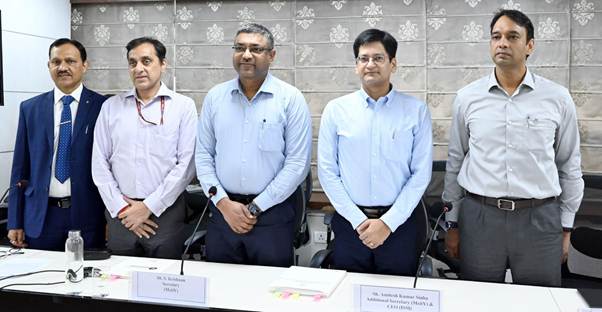
The two organisers announced the programme at a press conference in the capital on Tuesday. This year’s theme is “Silicon to Systems: Building the Ecosystem”.
What the three days will cover
The conference programme spans manufacturing and technology, artificial intelligence, supply chains, chemicals, gases and materials, government policy, sustainability, product design, start-ups, skilling, market development and leadership forums. Six international country roundtables are planned, along with a session on women’s empowerment and leadership, a workforce development session, and a special session on industry associations working together on India’s electronics manufacturing.
On the exhibition floor, organisers expect more than 500 exhibitors and over 240 international companies across 15,000 square metres. Delegations from more than 40 countries are due to attend, with six country pavilions and ten state government pavilions. There will also be a start-up pavilion and innovation showcase, a start-up pitch competition, a student hackathon and a workforce development pavilion. More than 150 international speakers are listed.
Among the companies expected are ASML, Applied Materials, Teradyne, Infineon, Ebara, Jabil, IBM Research, NXP, Tata Electronics, Micron, Merck KGaA, Rapidus, Lam Research, CG Power, Uno Minda, Advantest, Inox Air Products, HORIBA STEC, SCREEN, Everspin Technologies, Brewer Science, Polar Semiconductor, Tokyo Electron and Emergence AI.
Where the government’s chip programme stands
Twelve projects have been approved under the first phase of the Semicon India Programme. S. Krishnan, Secretary at the Ministry of Electronics and Information Technology, said three of those twelve have started commercial production. The Union Cabinet has since cleared a second phase, Semicon 2.0, built around six pillars.
“This year it is particularly significant for two reasons,” Krishnan said, pointing to the projects now in production and to the approval of the next phase.
The government has also been supplying chip design tools to more than 332 academic institutes and 105 start-ups. A further 24 start-ups have been approved under the Design Linked Incentive scheme.
Demand expected to double
Amitesh Kumar Sinha, Additional Secretary at the ministry and chief executive of the ISM, said global semiconductor requirement is expected to rise from about $1 trillion to $2 trillion, with India’s own requirement growing from around $100 billion to $200 billion.
Sinha said the event brings together governments and companies from abroad, Indian firms already cleared to set up manufacturing here, and others still weighing up whether to invest. Central and state policymakers and supply-chain firms are also expected.
‘Not simply to join the supply chain’
Ajit Manocha, President and chief executive of SEMI, said India is well placed to do more than take a seat in the existing order. “India’s opportunity is not simply to join the global supply chain, but to become integral to it,” he said, adding that SEMI has helped semiconductor hubs grow around the world for more than five decades.
Ashok Chandak, President of SEMI India and the India Electronics and Semiconductor Association, said corporate interest in this year’s edition has been strong and that the event has become the point in the calendar where industry, policymakers, researchers, start-ups and investors meet.
Chandak said a new feature this year, a “Sand to Silicon to Systems” value chain experience, shows how the country is moving from building credibility to demonstrating capability.