


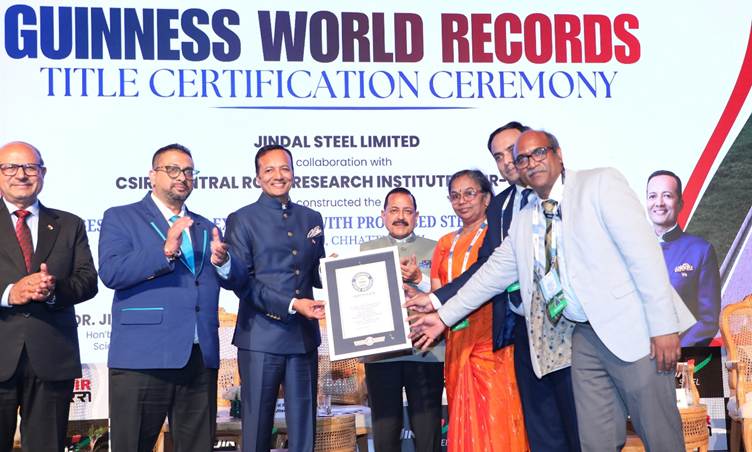
Raigarh (Chhattisgarh), September 12: India set a Guinness World Record for the world’s longest road built with processed steel slag aggregates on Saturday, with Union Minister Jitendra Singh saying the indigenous technology can cut road construction costs by around 40 per cent while making roads four times stronger than conventional ones.
The 1.85-km stretch at Raigarh was built jointly by the CSIR-Central Road Research Institute (CSIR-CRRI) and Jindal Steel Limited, using aggregates made from processed steel slag, a by-product of steel production. Singh, who holds independent charge of the science and technology ministry, said the technology can also stretch maintenance cycles, with major repairs needed only after about 15 years in suitable applications.
Singh called for the technology to move “from one project to many projects, from one State to many States”, saying its use should extend beyond the Ministry of Road Transport and Highways to the Railways, other government departments, state governments and private builders and contractors.
Certification ceremony marks Steel Grit brand launch
The Guinness World Records title, “World’s Longest Road Built with Processed Steel Slag Aggregates”, was conferred at a ceremony that also included the virtual inauguration of the road, the release of a scientific documentary, and the signing of a technology transfer agreement between CSIR-CRRI and Jindal Steel. The event also saw the launch of the “Steel Grit” brand and recognition for the project team.
Those present included Naveen Jindal, Member of Parliament and chairman of Jindal Steel; Dr N. Kalaiselvi, secretary of the Department of Scientific and Industrial Research and director general of CSIR; Dr V.K. Saraswat, a former NITI Aayog member and former director general of the Defence Research and Development Organisation; and Dr Ch. Ravi Sekhar, director of CSIR-CRRI, along with representatives of Guinness World Records, scientists and engineers.
Singh said the achievement showed how industrial waste could be turned into infrastructure wealth, linking it to Prime Minister Narendra Modi’s repeated emphasis on “waste to wealth” recycling. He said India’s expanding highways, expressways, industrial corridors, ports and urban infrastructure came with a growing responsibility to conserve natural resources such as aggregates obtained through mining and quarrying.
Minister points to Northeast rainfall and changing rural traffic
Singh said the technology’s value was especially high in a geographically diverse country such as India, where conventional roads often struggle in difficult terrain and high-rainfall regions. Recalling his seven years working on the Northeast, he said road construction there is often confined to four or five months a year because of heavy rain, and stretches built in one season can be damaged before the next construction cycle begins.
He also pointed to the changing traffic on rural roads, which are often built to connect villages and carry light vehicles but can end up carrying heavy trucks once the surrounding areas turn into industrial zones. Such shifts, he said, called for road technologies built for higher loads and longer durability.
Push to take technology beyond highways ministry
Singh said road construction was not confined to the highways ministry, with the Railways and several other government departments also building roads and heavy infrastructure, while private builders, contractors and infrastructure operators formed another major area for adoption. He called for greater engagement between ministries and states, including dedicated awareness programmes for engineers and implementing agencies.
He described the initiative as an example of “whole-of-government plus whole-of-nation” collaboration, and said CSIR-CRRI’s scientific guidelines, processing protocols and quality-control framework provided the basis for wider adoption. He also referred to other CSIR work on recycling, including biofuels made from used cooking oil and value recovered from electronic scrap, as part of a broader circular economy push.
Singh congratulated Dr Satish Pandey and the CSIR-CRRI team for taking the technology from research to the field, and credited Jindal Steel for providing the scale to demonstrate it in real infrastructure. He said he hoped more steel companies would come forward to work with scientific institutions on similar projects.
From Hazira to Arunachal Pradesh: where the technology has already been used
Processed steel slag aggregates have already been used in a six-lane road connecting the industrial area at Hazira, Gujarat, with Hazira Port, and on a one-kilometre, four-lane stretch of the NH-66 Mumbai-Goa Highway that used around 80,000 tonnes of processed slag. The technology has also gone into heavy-duty road infrastructure in Arunachal Pradesh, including in a strategic border region, and a 1.1-km steel slag road inside Hazira Port connecting its multi-purpose berth with the coal yard.
Next milestone: a 40-km road planned in Odisha
Dr N. Kalaiselvi said the record came as CSIR prepares to enter its 85th year, calling it a significant milestone for the organisation. She said CSIR-CRRI had received a work order for a 40-km road in Odisha from Jindal Steel’s Angul plant, which would take the technology far beyond the current 1.85-km record.
Kalaiselvi thanked Naveen Jindal and his team for the partnership with CSIR, and congratulated the scientists and engineers involved, particularly Dr Satish Pandey, for taking the technology from its early use in Gujarat to the national highway network, Arunachal Pradesh and now the Guinness World Record.
Singh said the world record should be seen as the start of the next phase rather than the destination, and that real success would come when the technology is replicated across the country wherever it is technically and economically suitable.