


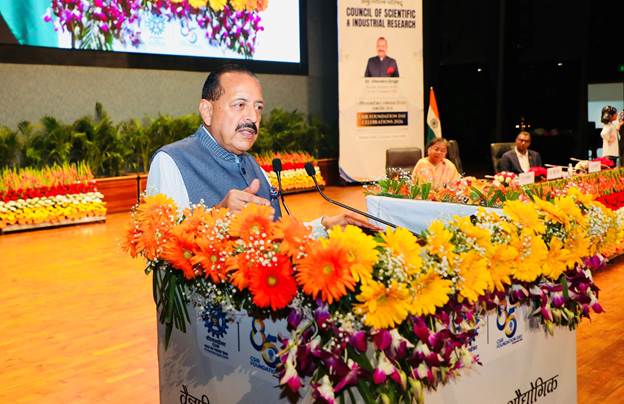
New Delhi, 25 September: India cannot remain dependent indefinitely on imported technologies in areas critical to its economy, security and development, Union minister Jitendra Singh said, calling technological sovereignty crucial to national sovereignty as the Council of Scientific and Industrial Research (CSIR) marked its 85th Foundation Day.
Addressing the celebrations at C. R. Subramaniam Hall in the NASC Complex, Pusa, Singh said CSIR laboratories must identify areas of critical technological dependence and build indigenous solutions that can compete globally on performance, quality and cost. India’s ambition, he said, must go beyond import substitution to becoming a technology provider to the world.
Industry as co-creator, not just a partner
Singh said CSIR must shorten the journey from laboratory to industry and from discovery to deployment. The usual practice of developing a technology first and then looking for an industry partner, he said, should give way to involving industry from the stage of defining the problem.
“Industry should be a co-creator, not only a partner,” he said. Scientists understand the science and what is technically possible, he explained, while industry understands the market, scale, cost and customer needs.
He encouraged large companies, MSMEs and startups to treat CSIR laboratories as research and development partners. Starting a startup may be relatively easy, he added, but sustaining one needs stronger links between technology, industry and the market.
National missions and critical technologies
Singh referred to India’s work in nuclear energy, clean energy and other emerging areas, and said the coming years would increasingly test the country’s ability to develop and control critical technologies. He cited the National Quantum Mission, IndiaAI Mission and India Genome Mission as part of a cross-generational and cross-ministerial approach to science and technology.
Among newer technologies from CSIR laboratories, he listed electric tractors, indigenous pharmaceutical technologies, food technologies, continuous-flow processes, advanced road technologies, solar technologies and mechanised sewer-cleaning solutions.
New CSIR mascot and postal stamp
During the celebrations, Singh unveiled CIRA, short for CSIR’s Innovation and Research Ambassador, as the organisation’s new mascot. He also released a CSIR@85 special postal stamp, the CSIR Industry Connect Video and the CSIR Technology Compendium.
The programme included a CSIR-Industry Technology Exhibition, technology transfers and the CSIR Sci-Art Gallery. More than 40 ambassadors from 14 countries attended and joined the visit to the CSIR exhibits.
A network of 37 CSIR laboratories
Dr N. Kalaiselvi, Secretary of the Department of Scientific and Industrial Research (DSIR) and Director General of CSIR, described CSIR@85 as a historically important, scientifically significant and strategically important milestone. She said CSIR has a network of 37 laboratories and more than 10,000 personnel.
Singh noted that CSIR began its journey in 1942, before Independence. Its laboratories’ work in areas ranging from leather technologies and jewellery to healthcare, agriculture, road technologies, food technology and aerospace had become linked with the identity of different states and regions, he said. Scientific institutions, he added, should be open enough for citizens to know what is being developed and how they can benefit from it.
“When India reaches 2047, I wish CSIR would have lived up to its legacy and travelled and progressed beyond 2047,” he said.
Singh is Union Minister of State (Independent Charge) for Science and Technology and Earth Sciences, and Minister of State in the PMO and for Personnel, Public Grievances, Pensions, Atomic Energy and Space. As part of the Foundation Day, he also launched popular science magazines in five Indian languages. A day earlier, he launched PLA bioplastics under the BioE3 programme.