


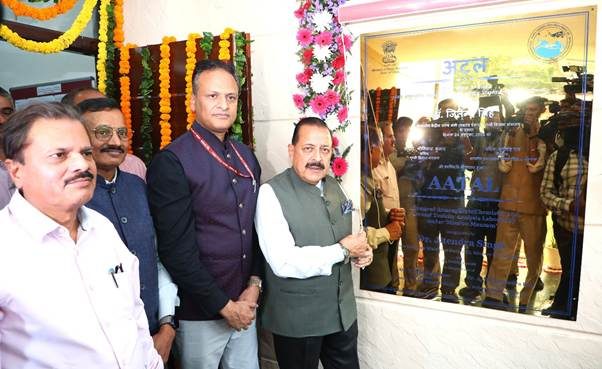
New Delhi, October 24: Union Minister Dr Jitendra Singh on Saturday inaugurated a new laboratory that will identify what Delhi-NCR air pollution is made of and where it comes from, in real time.
The Integrated Atmospheric Chemistry and Aerosol Toxicity Analysis Laboratory (AATAL) has been set up at the Delhi branch of the Indian Institute of Tropical Meteorology (IITM) under Mission Mausam. The minister described it as the first integrated facility of its kind in the world.
Beyond AQI numbers
“Earlier, the discussion would largely revolve around whether the pollution level was 100 or 200. This facility will help us understand the composition of pollution as well as the contribution of different sources,” Singh said.
The laboratory will separate the share of vehicle emissions, industry, biomass and crop-residue burning, construction and road dust, and pollution carried in from surrounding regions. Its instruments analyse the chemical makeup of gases and aerosols, including fine particulate matter (PM2.5), metals and toxic elements.
Speaking to reporters, Singh pointed out that the screen at that moment showed transport contributing about 25 per cent of Delhi’s air pollution, with the overall pollution level at around 180.
Health implications
Singh said pollutants differ in their health effects, so their composition and potential toxicity matter as well as how much of them is in the air. The data is expected to help health authorities understand the risks linked to different types of particulate pollution and to support closer work between scientific, health and environmental agencies.
Linked to AIRWISE forecasts
AATAL is integrated with IITM’s AIRWISE system, which gives air-quality forecasts at a 400-metre resolution for the next 72 hours. Dr Sachin Ghude, Project Director of MAQWS, said the combined system would help the Commission for Air Quality Management (CAQM) and other agencies identify the main sources of pollution, plan targeted action and check whether it works. The information can also support decisions under the Graded Response Action Plan (GRAP).
Singh said air pollution could not be tackled by one department working alone and called for coordination between the Ministry of Earth Sciences, the Ministry of Environment, Forest and Climate Change, pollution-control authorities and disaster-management agencies.
Ministry of Earth Sciences Secretary Dr T. Srinivasa Kumar, IITM Director Dr A. Suryachandra Rao and IMD Director General Dr Mahapatra were present.
Related: Nuclear power will help meet AI and data centre demand, says Jitendra Singh