


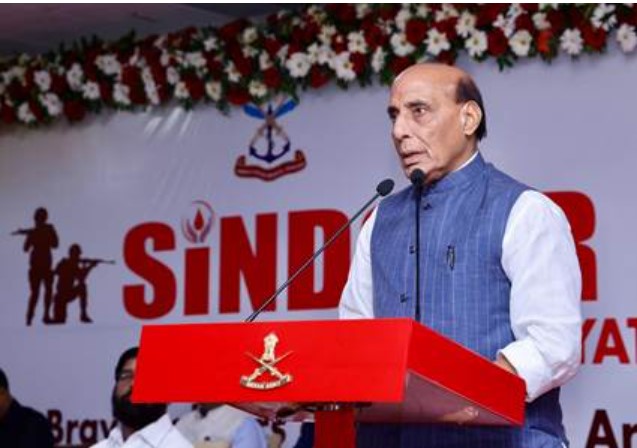
Bengaluru, September 18: Hindustan Aeronautics Limited (HAL) handed over two Light Combat Aircraft (LCA) Tejas trainers, the Final Operational Clearance (FOC) twin-seater version, and three HTT-40 basic trainers to the Indian Air Force, and four Dhruv Next Generation (NG) helicopters to Pawan Hans Limited, in Bengaluru on Friday. Defence Minister Rajnath Singh and Civil Aviation Minister K Rammohan Naidu were present at the ceremony.
Rajnath Singh called the handover a milestone in India’s progress towards indigenous aerospace capability, technological self-confidence and self-reliance. “Our aim is to make India capable, self-reliant, and globally competitive in meeting its aerospace requirements,” he said.
What was handed over
The two Tejas trainers are the last two aircraft under the FOC contract. They will support the Air Force’s training needs and give pilots an indigenous training path into frontline fighter operations. The trainer keeps the core systems and combat capability of the frontline Tejas, so pilots train on the type of aircraft they will later fly in service.
The HTT-40 (Hindustan Turbo Trainer-40) is an indigenously designed and developed basic trainer meant for the primary training needs of the Defence Forces. It has a turboprop engine, a modern cockpit and avionics suite, and can be used for aerobatics, general handling, instrument flying, navigation, night flying and close formation flying. Rajnath Singh said India relied on imported aircraft for basic training for years, and HAL now makes the HTT-40 for the Air Force. He said he expects the aircraft to find demand in international markets.
The Dhruv NG is configured for civil operations, with enhanced systems, modern avionics and a more powerful engine. It is meant for passenger transport, emergency medical services and offshore logistics support, and marks HAL’s entry into the civil and commercial helicopter segment. Naidu said the certification and induction of the Dhruv NG into civil operations is an important milestone for India’s civil aviation ecosystem and shows the growing ability of Indian industry to develop and support advanced aerospace platforms for commercial use. HAL Chairman and Managing Director Ravi K said the handover shows HAL can develop and deliver platforms for both civil and defence needs.
Rajnath Singh on self-reliance and timelines
Rajnath Singh said the Government has taken steps to let Defence Public Sector Undertakings advance in the defence sector while also encouraging private industry, with a level playing field. He said aerospace cannot progress through a sudden “big bang”. It is a gradual process with many components, he said, each one a small rung on a long ladder, and challenges should be treated as milestones on a larger roadmap.
He asked for an integrated aerospace ecosystem that serves both civil and military aviation. Skills in aircraft design, avionics, propulsion, composite materials, flight control systems, manufacturing and certification, once developed within the country, benefit the whole sector, he said.
The Defence Minister also asked for realistic project timelines. Delays in technical projects can leave gaps in meeting critical defence requirements, push up costs and raise the risk of technology becoming obsolete, he said. He said the nature of modern warfare is changing fast and future air operations will be information-intensive and technology-driven. Combat effectiveness, he said, depends on trained personnel, advanced technology, integrated systems and quick decisions, and the Tejas trainer will play a part in preparing pilots for this.
Turning to HAL, he described it as a pillar of India’s effort to build indigenous aerospace capability and asked it to expand across design, development, manufacturing, certification, lifecycle support and global marketing. He said public and private sectors should be seen as collaborators, not competitors, and that India must prepare for the effect of artificial intelligence, autonomous systems, unmanned aerial systems, electronic warfare, cyber technologies and next-generation propulsion, with a focus on developing and integrating them indigenously. He also urged young scientists, engineers, designers, test pilots and technicians to work on technologies that do not exist today.
Chief of the Air Staff Air Chief Marshal AP Singh, Defence Production Secretary Sanjeev Kumar and Civil Aviation Secretary Samir Kumar Sinha also attended.
Source: Press Information Bureau release, 18 September 2026: HAL hands over 2 LCA FOC Twin Seater Trainers and 3 HTT 40 Basic Trainers to IAF and 4 Dhruv NG helicopters to PHL in the presence of Raksha Mantri and Civil Aviation Minister.