

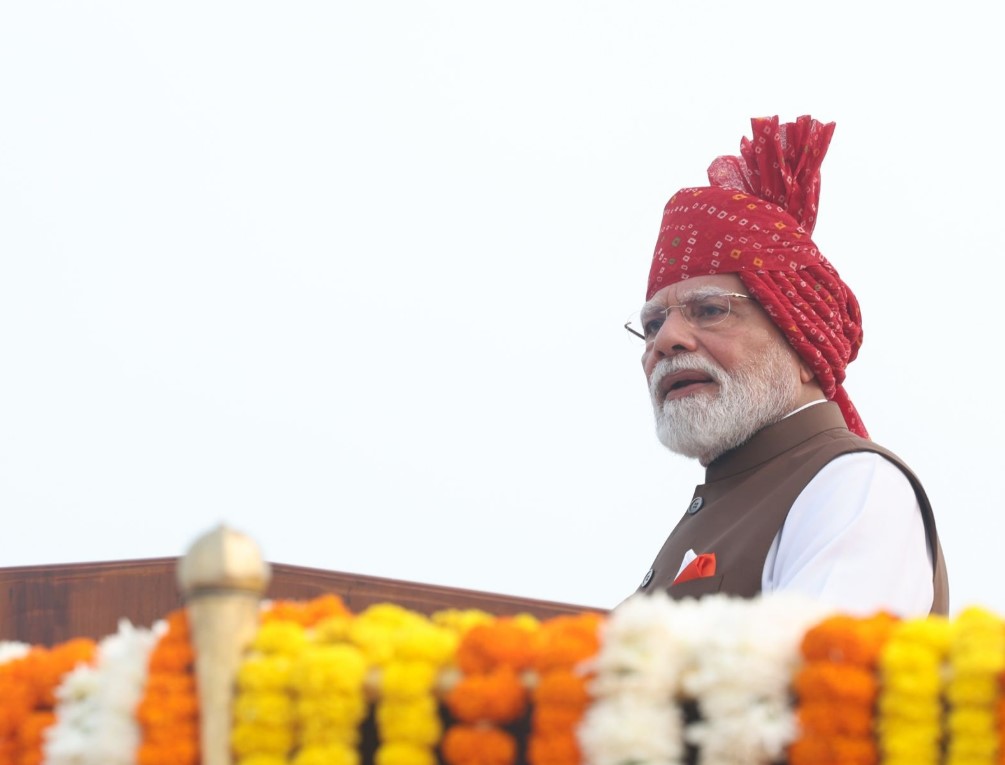
New Delhi: Prime Minister Narendra Modi has announced that one crore young people will be trained in artificial intelligence skills over the coming year, in an Independence Day speech that laid out a seven-part plan for making India a developed country by 2047.
Speaking from the ramparts of the Red Fort on the 80th Independence Day, Modi said the AI training would give young Indians the ability to lead in that field rather than follow. He paired it with several other announcements: a new civil defence network, a nationwide talent hunt to spot sporting ability in children aged between 5 and 15, and an appeal to every political party to clear 33 per cent reservation for women in the Lok Sabha and state assemblies.
He said Vande Mataram was being sung from the Red Fort on 15 August for the first time since Independence, in the year the song completes 150 years. Before turning to policy, he remembered the freedom fighters and revolutionaries who died for Independence, and told families hit by the recent floods and landslides that the country stood with them.
Seven streams of strength
Much of the address was built around what Modi called the ‘Sapt Dhara’, or seven streams of strength: manufacturing, agriculture and food production, technology and innovation, Gati Shakti connectivity, defence, the green and blue economy, and India’s soft power. The target of a Viksit Bharat by 2047, he said, depends on the work of 140 crore citizens.
He also said reform could not be left to the government alone. Industry, producers, farmers and society would all have to change how they work, and state governments and local bodies would have to speed up. Policies written for the last century, he said, cannot run a country aiming at 2047.
Chips, 6G and a bet on start-ups
Modi said three semiconductor plants have already been started and another five to eight are expected over the next seven to eight years. Chips now sit inside everything from medical equipment to transport systems, he said, and a world without them would come to a halt.
On technology more broadly, he said India should not settle for being a market for other countries. He wants Indian digital public technologies exported the way UPI has been, and Made-in-India 6G reaching the rest of the world.
The country now has more than 2.5 lakh registered start-ups, and the government has announced a ₹1 lakh crore Innovation Fund. Modi pointed to private start-ups founded by people with an average age of 28 that put satellites and rockets into orbit on their first attempts. The bioeconomy, he said, has grown from a turnover of ₹60,000 crore before 2014 to ₹20 lakh crore.
Twelve years counted in multiples
A long stretch of the speech was given over to figures from the past 12 years. Defence production is up nearly fourfold and khadi and village industries output nearly fivefold. Electronics manufacturing has grown around sevenfold, modern railway coach production 21-fold and mobile phone manufacturing 35-fold. Digital transactions are up a hundredfold, and patents granted fourfold.
On everyday services, Modi said tap water connections are now being given 15 times faster each year than before, gas connections six times faster, toilets for the poor four times faster and houses for the poor three times faster. Twenty-five crore people have moved out of poverty, and a country once grouped among the Fragile Five is now the fastest-growing of the major economies.
Railway electrification made a similar point. Work began in 1925, but only about 30 per cent of the network had been electrified by 2015. The rest was finished in a decade. India has also introduced a hydrogen-powered train, which Modi said is the longest and most powerful of its kind.
Quality, exports and a Fortune 500 target
India has signed free trade agreements with close to 40 countries since 2014, and Modi told MSMEs not to let that opening pass. Textiles, machinery and medicines all have to reach global markets, he said, and Indian products have to beat the standards of what the country imports. His message to manufacturers was blunt: “our mantra must be: Quality, Quality, Quality.”
He set out several targets for Indian business. Fifty Indian companies in the Fortune 500 within a decade. An Indian bank among the world’s top five. One or two Indian pharmaceutical firms among the world’s five largest.
Cheaper fertiliser, and farm exports
Modi said the government is carrying a heavy subsidy burden on fertiliser. A bag of urea that costs 3,000 rupees on the global market is sold to farmers at 300 rupees, and DAP, which has now reached 5,000 rupees globally, is being supplied at 1,350 rupees.
He urged farmers to move into food processing and chemical-free farming, saying demand for such produce will grow. Fisherfolk along the coast, from Keralam to Gujarat and Tamil Nadu to Bengal, have already seen better prospects for shrimp exports because of the trade agreements.
Nuclear, solar and piped gas
Energy security ran through the speech. With the SHANTI Act now passed in Parliament, the government is working towards 100 GW of nuclear capacity by 2047 and five new reactors this decade. India crossed a mark this year by mastering fast breeder reactor technology, which Modi said takes the country closer to being self-reliant in nuclear fuel.
Solar capacity has gone from 2 GW twelve years ago to 160 GW. More than 50 lakh households have taken up rooftop solar under the PM Surya Ghar Muft Bijli Yojana, with the government giving 80,000 rupees to each family. Many now have zero electricity bills and some are earning from the surplus they sell back.
Piped gas has expanded from 70 cities to 700, and from barely 20-22 lakh households before 2014 to about 1.75 crore now. The government has also launched a National Critical Minerals Mission and announced a Critical Minerals Corridor in the Budget.
Defence exports, Naxalism and a civil defence network
Defence exports have grown nearly 50-fold and Indian weapons and equipment now go to around 100 countries. Work on Mission Sudarshan Chakra is moving quickly. Modi said India must build drones and counter-drone systems, take the lead in hypersonic technology and treat cybersecurity as part of defence.
On internal security, he said Naxalite-Maoist violence held parts of the country under the gun for four decades and cost the lives of more than 3,500 police and security personnel. Armed Naxalites have been defeated, he said, but the mindset survives and is looking for ways back in through violence and disorder.
That led to one of the day’s announcements. Warfare no longer stays on the battlefield or the border, Modi said, and the government will build a civil defence network, equipping citizens and civil defence staff with modern systems and training.
Lakhpati Didis and a push on women’s reservation
The government has passed its target of three crore Lakhpati Didis and is now working towards six crore. Standing at the Red Fort, Modi appealed to all political parties to bring in 33 per cent representation for women in the assemblies and the Lok Sabha. “You also take the fame, you also take the credit, but give rights to my mothers and sisters,” he said.
On welfare, he said social security cover reached 25 crore people over five to seven decades and 100 crore in the past decade alone. Ayushman Bharat now covers free treatment worth up to ₹5 lakh for citizens aged 70 and above. Nearly 3.25 crore families have gained from the SVAMITVA scheme, unlocking assets worth about ₹140 lakh crore that can be used to raise bank loans.
Universities, tinkering labs and free coaching
Fewer than 350 universities existed between 2004 and 2014, Modi said, and nearly 650 have been added since, taking the count close to 1,000. Foreign universities are setting up in India, and students can now earn foreign degrees without leaving the country.
More than 10,000 Atal Tinkering Labs have been opened for schoolchildren. The government also plans a network offering free online coaching for competitive examinations, using existing digital infrastructure and teachers.
A talent hunt for the 2036 Olympics
India will host the Commonwealth Games in 2030 and wants the 2036 Olympics. Modi said the country still does not compete in, or qualify for, a large share of Olympic events, and about three-quarters of the opportunities remain untouched.
To change that, a talent hunt will run through villages, cities and schools to find children aged 5 to 15 with sporting ability, assess them and put them through special training. He also called for drug addiction to be treated as a shared problem, under the Nasha Mukt Bharat campaign.
An appeal on the Census
With the Census under way, Modi asked young people to sit down with their families and go through the form properly. The numbers feed into policy and planning, he said, so accuracy matters.
He closed by returning to the Panch Pran he had spoken of in earlier addresses, and to the 2047 goal. “One lamp will light thousands of lamps,” he said, asking citizens to turn dreams into resolve, resolve into strength and strength into success.