


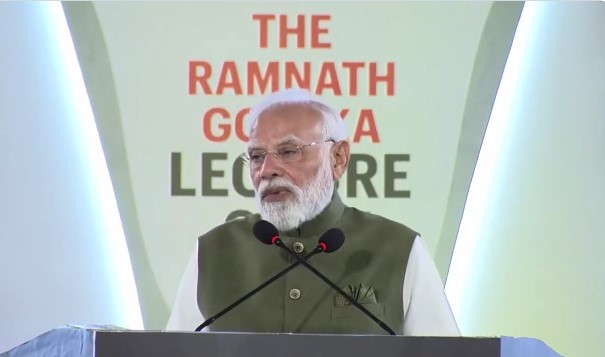
New Delhi, September 19: Prime Minister Narendra Modi inaugurated the National Green Tribunal’s two-day International Conference on ‘The Future of Environment and Climate Dynamics’ in New Delhi on Saturday and launched the NGT mobile application at the inaugural session. Jurists, academics, policymakers, scientists and environmental experts from 17 countries are taking part, along with the United Nations Environment Programme (UNEP) and the Asian Development Bank (ADB).
Chief Justice of India Justice Surya Kant, Attorney General R. Venkataramani, Environment Minister Bhupender Yadav and NGT Chairperson Justice Prakash Shrivastava were at the inaugural session.
Prime Minister on emissions and clean energy
Modi said India has guided the world on nature and the environment for centuries and is now offering solutions to modern climate challenges. He said responsibility for carbon emissions has often been wrongly placed on developing countries. India’s per capita carbon emissions are less than half the global average, he said, while per capita emissions in developed countries are six times higher than India’s.
He described India as the only G20 country that has met all its commitments from the COP-21 summit in Paris, and met them ahead of schedule. On solar power, he said capacity was about 2 gigawatts 12 years ago and has now crossed 160 gigawatts. Under the PM Surya Ghar scheme, more than 5 million homes have installed rooftop solar panels with financial assistance of up to ₹80,000 per household, and under the KUSUM scheme solar pumps have been installed in the fields of 3 million farmers. Solar power alone, he said, has prevented nearly 200 million tonnes of carbon emissions.
Wind capacity has tripled in 12 years and non-fossil capacity has nearly quadrupled, Modi said. The government is also working on nuclear power generation and has created a pathway for private players to enter the sector. He also mentioned coal gasification and green hydrogen, and said India’s first hydrogen train was launched a few days ago, which he called the world’s longest hydrogen train.
Transport, water and forests
Modi said fewer than 3,000 electric vehicles were sold in India in the year before 2014, against nearly 2.5 million last year. Before 2014 only five cities had metro networks, totalling less than 250 kilometres; metros now run in more than 20 cities and the network is over 1,000 kilometres. Railways are nearly 100 per cent electrified, a 3,000-kilometre Dedicated Freight Corridor was inaugurated this month, and about 5,000 kilometres of waterways are in use for transport.
On water, he cited more than 70,000 Amrit Sarovars and nearly 15 million water harvesting structures built under the Catch the Rain campaign. More than 20 million farmers are connected to modern irrigation under the Pradhan Mantri Krishi Sinchai Yojana. Under the National Mission on Natural Farming, about 1.25 million hectares have developed 24,000 clusters, and nearly 3,000 varieties of climate-resilient crops have been developed, he said. Very dense forest cover, he added, has increased by more than 22 per cent in 12 years.
He said India has banned single-use plastic and is promoting the circular economy, and that the GOBARdhan scheme converts cow dung and other organic waste in villages into useful resources. Modi closed by quoting the Sanskrit line “Mata bhumih, putro aham prithivyah”, which he translated as: this earth is our mother and we are her children.
Chief Justice, Attorney General and Environment Minister
Chief Justice Surya Kant said the Supreme Court has, over the decades, recognised the right to a pollution-free environment as a fundamental right. It has also developed principles including the precautionary principle, the polluter pays principle, absolute liability and the public trust doctrine. He said adverse effects of climate change can implicate fundamental rights relating to equality, livelihood and health, and called for judicial wisdom, scientific knowledge and international cooperation.
Attorney General Venkataramani said no country can address the environmental challenge alone and that global action must move beyond declarations towards practical and enforceable mechanisms. He called for a new global environmental regulatory framework and stronger international institutions to deal with environmental justice.
Bhupender Yadav said non-fossil sources now account for 54.18 per cent of India’s installed electricity capacity, passing the 2030 target of 50 per cent nine years early. India ranks third in the world in installed renewable energy capacity and is the second-largest solar growth market, he said. He also gave India’s forest and tree cover as 8.27 lakh square kilometres and said the UN FAO’s Global Forest Resources Assessment 2025 places India third globally for annual net forest-area gain.
Looking ahead to UNFCCC COP31 in Antalya, Yadav said India will continue to argue for climate action centred on equity, implementation and the needs of vulnerable countries. He said the choice before the world is not between development and environment, but between sustainable development and development that cannot be sustained.
Conference sessions
NGT Chairperson Justice Prakash Shrivastava said environmental protection is a collective national and global responsibility, and that the consequences of degradation often fall most severely on those least responsible for them.
The conference has four technical sessions, two of which were held on Saturday. The first, ‘Climate Justice, Equity and Inclusion: From Principles to Action’, looked at equity in climate action and environmental and social safeguards. The second, ‘The Future of Environmental Law and Governance’, covered institutions and enforcement, liveable cities, the energy transition, green infrastructure and green finance. The organisers say the conference aims to produce actionable recommendations and a roadmap for future cooperation.
Source: Press Information Bureau releases, 19 September 2026: Prime Minister inaugurates International Conference on ‘The Future of Environment and Climate Dynamics’; releases NGT mobile application and English rendering of the Prime Minister’s address.