

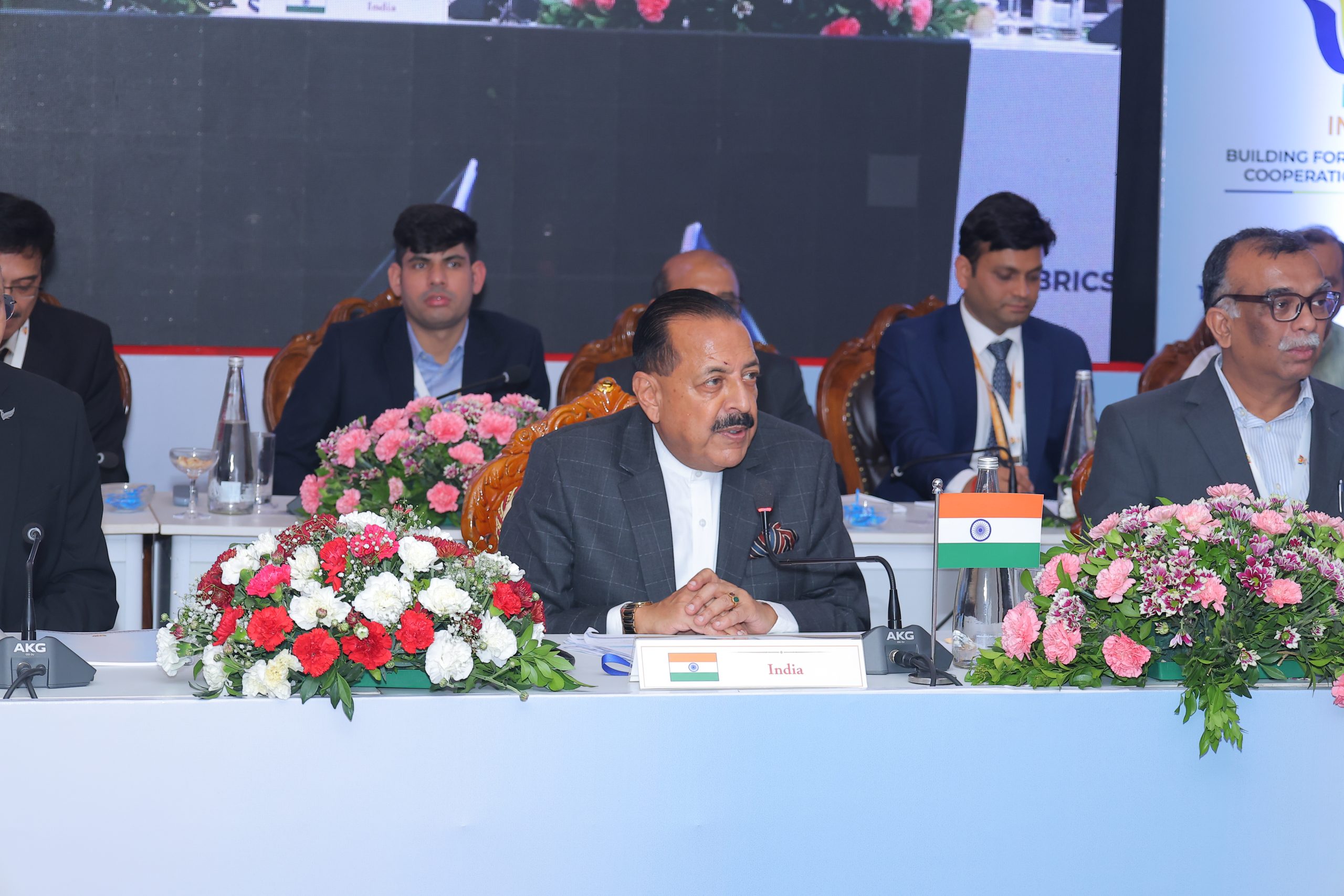
Kolkata, September 6: Union Minister Dr Jitendra Singh has called for a new model of engagement between industry and research institutions, under which commercial partners are brought into a project at the planning stage itself rather than after a technology is ready.
Singh, who holds independent charge of the Science and Technology and Earth Sciences ministries, made the appeal during an interaction with chief executives, chief operating officers and chief strategy officers of various industries at the 6th RISE Conclave, held at CSIR’s Indian Institute of Chemical Biology in Kolkata. He said the commercial arm of a project should be associated with the laboratory from day one, so that market needs and practical constraints shape a technology while it is still being developed.
Responding to a suggestion from industry that commercial partners be involved from the laboratory stage itself, Singh said early participation would let companies weigh in on market dynamics, design, environmental sustainability, supply chains and commercial viability, rather than a technology reaching the market only to need modification for real-world use.
Critical minerals and a steel-sector platform
The interaction became a working session where industry raised specific technologies and challenges. Critical minerals featured heavily, with participants discussing rare-earth extraction, permanent magnets, recycling, lithium beneficiation and the recovery of strategic minerals such as vanadium and titanium, along with the potential for exploration in eastern India. Singh said the government wanted to make fuller use of capabilities already being built across CSIR laboratories and other scientific agencies.
Industry representatives also raised issues in space technology and specialised optical components, which Singh said could be taken up with the Department of Space. He noted that regulatory simplification was already under way and invited further specific suggestions from industry.
On the foundry sector, Singh proposed a common research and development facility, with industry players coming together to define their requirements and government helping set up the platform. He extended a similar offer to steel producers, saying the government was ready to provide a forum if companies across the sector organised themselves as a group and asked for one.
Antivenom and snakebite technology discussed
Bengal Chemicals and Pharmaceuticals raised the possibility of reviving indigenous production of anti-snake venom, pointing to the distinct snake species found in eastern India and the region’s specific requirements. Singh advised the company to engage with the West Bengal health ministry to ensure any such effort aligned with scientific and public health needs.
A startup working in the same space then presented technology for identifying the snake species responsible for a bite and for developing new antivenom treatments. Singh welcomed the innovation but said it would need proper scientific validation and clinical trials before wider use, stressing that patient safety could not be compromised, and again pointed the innovators towards the state health ministry for the necessary approvals.
‘Tell us what more we can do,’ says minister
Through the session, Singh pressed industry representatives to move from general discussion to specific, actionable requests, saying the government and scientific institutions would help make the necessary connections. “You tell us what we can do for you or what we are not doing for you, or what we can do better for you,” he said. He added that industry did not need to wait for formal events like the conclave to raise further inputs.
The 6th RISE Conclave, organisers said, reinforced a model in which industry acts as an R&D partner from the outset, scientific institutions serve as technology enablers, and government facilitates the journey from laboratory research to market and wider public use.