


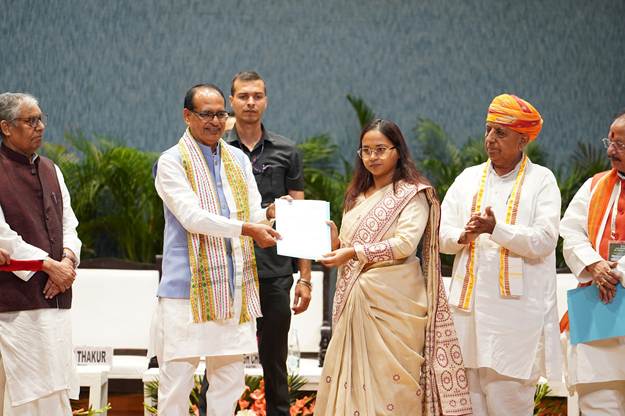
New Delhi, September 29: Union Agriculture Minister Shivraj Singh Chouhan has handed over sanction letters worth more than ₹1,200 crore to 10 states under the Prime Minister Rashtriya Krishi Vikas Yojana (PM-RKVY). He also announced monthly Centre-state reviews and a nationwide ‘Khet Bachao Abhiyan’ to protect soil health, running from 22 October to 30 November.
The announcements came on the second day of the National Agriculture Conference – Rabi Campaign 2026, where Chouhan, who is Union Minister for Agriculture and Farmers’ Welfare and Rural Development, chaired a session with state agriculture ministers and senior officials.
How the PM-RKVY money is split
West Bengal received the largest sanction at ₹290 crore, followed by Haryana (₹198 crore), Chhattisgarh (₹181 crore), Arunachal Pradesh (₹154 crore), Bihar (₹114 crore) and Karnataka (₹104 crore).
Mizoram was sanctioned ₹75 crore, Himachal Pradesh ₹64 crore, Jharkhand ₹58 crore and Punjab ₹43 crore. Chouhan said the Centre wanted states to have the money in time so that work on the ground could begin without delay.
‘Team Agriculture’ above party politics
Chouhan urged the Centre and the states to set politics aside and work as ‘Team Agriculture’ on food security and farmers’ incomes. “Governments and political parties come and go; parties are formed and dissolved, but the country and its farmers are eternal,” he said, adding that the conference was about practical ways to improve farming.
Ministers of State for Agriculture Ram Nath Thakur and Bhagirath Choudhary, Agriculture Secretary Atish Chandra and ICAR Director General M. L. Jat attended, along with scientists and officials from the Centre and the states.
According to Chouhan, the agriculture growth rate has risen from 3 per cent to 4.5 per cent since 2015. The average yearly rise in foodgrain production has more than doubled, from around 40 lakh tonnes to 84 lakh tonnes, and rabi foodgrain output grew by 205 lakh tonnes between 2023-24 and 2025-26.
Monthly reviews and a fixed meeting calendar
Monthly virtual review meetings will now be held with states, on the lines of the weekly reviews at the Centre. Each state will form a State Agriculture Team that includes the agriculture minister and secretary, agricultural universities, ICAR institutes, Krishi Vigyan Kendras, ATMA, farmer producer organisations, progressive farmers, processors, exporters and Central nodal officers.
Districts will hold monthly meetings of the Collector, the Deputy Director of Agriculture, ATMA, KVKs, ICAR scientists, bankers and farmers.
A yearly calendar has also been fixed for pre-season planning. For the kharif crop, district meetings will take place on 10 May and state meetings on 17 May. For rabi, the dates are 10 September and 17 September. A one-day special meeting will also be held across the country on a common date.
Khet Bachao Abhiyan and pulses in eastern India
The Khet Bachao Abhiyan will use Soil Health Cards to promote balanced fertiliser use, with the aim of protecting soil fertility and beneficial insects. Scientists and other stakeholders will take part.
Chouhan also called for large-scale pulse cultivation in rice fallow land after the paddy harvest in eastern India, particularly in Jharkhand, Bihar, Odisha and West Bengal.
Rabi season directions to states
Crop and seed recommendations this rabi season should be based on soil moisture and water availability, the minister said. States have been told to protect crops from pests and diseases, cover every eligible farmer with a Kisan Credit Card and carry out transparent crop cutting experiments under the crop insurance scheme.
Chouhan said seed and fertiliser supplies are adequate. He asked states to take strict legal action against fake fertilisers, spurious seeds and sub-standard pesticides, and to end forced tagging completely. He also asked them to push natural farming, integrated farming systems and crop diversification in mission mode.
Full MSP procurement of tur, urad and masoor
Chouhan said there would be 100 per cent assured government procurement of tur, urad and masoor at the minimum support price (MSP), with payment within 48 hours. Post-harvest management, scientific warehousing and marketing are also to be strengthened.
He added that India would use new openings from international free trade agreements to take its fruit, vegetables, foodgrains and other farm produce to global markets, which he said would help farmers get better returns.
Related: Centre cuts edible oil duties, asks industry to lower retail prices | GST reforms to deliver relief for farmers, says Shivraj Singh Chouhan